
Can Slurry Pumps Resist Corrosion and Abrasion Without Frequent Repairs?
Yes, a slurry pump can handle both corrosion and abrasion without frequent replacement, provided its wetted materials and operating conditions suit the actual slurry. No material resists every chemical and every type of particle damage equally well. A pump that lasts in a fine, mildly acidic slurry may fail quickly when exposed to sharp fragments, stronger chemicals, or a higher operating temperature.
The practical goal is to keep wear predictable and extend the interval between planned repairs. That requires comparing materials against both the liquid chemistry and the solids, then checking whether the pump’s hydraulic design and operating point support that choice.
When asking, “Can a slurry pump handle both corrosion and abrasion without frequent replacement?” the most useful follow-up is: what is causing the present damage? Replacing an unsuitable alloy with a harder one will achieve little if chemical attack is weakening its surface.
Why corrosion and abrasion are harder to control together
Abrasion removes material mechanically as particles strike or slide across the impeller, liners, and casing. Corrosion attacks material chemically or electrochemically. In a slurry pump, these processes can reinforce each other.
Particles can strip away protective surface films, exposing fresh metal to the liquid. Corrosion can weaken the material around hard phases in an alloy, allowing those phases to break away under particle impact. The resulting damage may be more severe than either mechanism would suggest on its own.
This explains why two common purchasing shortcuts fail. Choosing the hardest available metal does not establish chemical compatibility. Choosing a corrosion-resistant alloy does not establish resistance to abrasive solids.
Even pH gives only part of the picture. Temperature, acid type, chlorides, oxidizing conditions, and chemical concentration can change how a material behaves. Cleaning solutions and occasional process upsets also matter, particularly if they are more aggressive than the normal slurry.
Comparing the main material options
The strongest candidate depends on which damage mechanism dominates and which operating limits cannot be avoided. The following comparison provides a starting point for material selection.
High-chromium iron versus corrosion-resistant alloys
High-chromium white iron is widely used for abrasive slurry service because its hard microstructure resists particle wear. It can be a strong choice for mineral slurries when the carrier liquid is compatible. However, the word “chromium” should not be treated as proof that the material behaves like a corrosion-resistant stainless steel.
Stainless steels, duplex grades, and nickel-based alloys offer different forms of chemical resistance. Their suitability depends on the specific environment, and their abrasion resistance varies. A material selected for an aggressive liquid may still lose metal quickly when hard particles repeatedly strike its surface.
For mixed corrosion and abrasion, compare the proposed alloy grade against the complete duty. A broad description such as “stainless construction” is too vague to support a reliable choice.
Rubber versus polyurethane and other elastomers
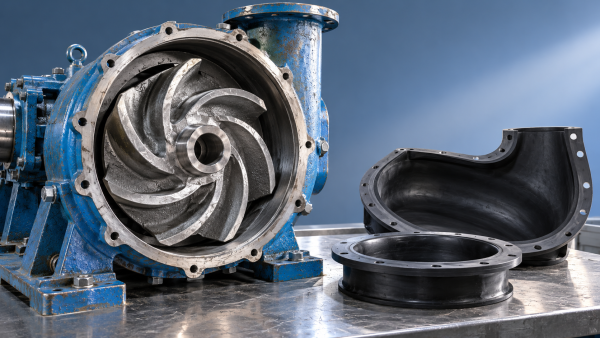
Rubber can perform well because it deforms under particle impact instead of resisting wear through hardness alone. Fine particles may cause less damage to a suitable resilient surface than to an unsuitable metal surface. Rubber-lined pumps can therefore be useful where both chemical compatibility and abrasive wear need attention.
That advantage has limits. Sharp fragments can cut or tear a lining, while incompatible chemicals can cause swelling, softening, or embrittlement. Temperature also affects strength and durability. Natural rubber is generally unsuitable for many oils and hydrocarbon-containing liquids.
Polyurethane and synthetic elastomers provide other combinations of wear resistance and chemical compatibility. They are not interchangeable upgrades. A compound that handles sliding abrasion well may be unsuitable for the temperature or chemistry involved. Selection needs to reach the compound level, including the properties of any backing or bonding system exposed during service.
When ceramics deserve consideration
Ceramics can combine high abrasion resistance with useful chemical resistance in suitable environments. They deserve consideration when conventional metallic components wear too quickly and the slurry chemistry is compatible with the proposed ceramic.
The tradeoff is sensitivity to mechanical and thermal stresses. Large debris, sudden temperature changes, or poor support can crack a hard ceramic component. The joints, attachment method, and surrounding structure require as much attention as the wear surface itself.
The same material can succeed or fail depending on pump operation
A suitable material cannot compensate indefinitely for damaging flow conditions. A pump operating far from its intended duty may develop recirculation, uneven loading, and concentrated wear. Damage can then appear at the impeller inlet, vane edges, or other regions where flow separates or changes direction sharply.
Select the pump around the required flow and head, accounting for how the slurry affects performance. Check the normal duty against the manufacturer’s recommended operating range, including realistic changes in production rate and slurry concentration.
Speed deserves particular attention. Higher particle velocity generally increases erosive wear, but simply reducing speed may leave insufficient head or allow solids to settle in the pipeline. A larger, slower-running pump can sometimes reduce wear, provided it still meets the hydraulic duty and maintains suitable solids transport conditions.
Passage size and impeller geometry also affect reliability. A pump handling occasional coarse fragments needs enough clearance to pass them. Otherwise, blockage or impact damage can dominate service life even when the material handles the normal slurry well.
Suction conditions can create another source of damage. Restricted suction piping, entrained air, unstable sump levels, or inadequate available suction head can contribute to cavitation and irregular operation. Cavitation causes localized damage that may be mistaken for ordinary abrasion. Installing tougher wet-end parts leaves the underlying problem unresolved.
What the failed parts can tell you
Before choosing a replacement pump or changing materials, inspect the damage pattern. It often provides a better starting point than the original equipment specification.
- Grooves and directional thinning can indicate particle abrasion or concentrated flow.
- Pitting, widespread chemical attack, or damage during idle periods can point toward corrosion.
- Swollen, softened, cracked, or peeling elastomer can indicate chemical incompatibility, excessive temperature, or bonding failure.
- Localized crater-like damage near low-pressure regions can suggest cavitation.
- Broken edges or fractured liners can indicate impact, trapped debris, assembly stress, or unsuitable handling.
These patterns are clues, and several mechanisms may occur together. Compare the damaged areas with operating records: flow changes, chemical additions, temperature excursions, suction problems, and unusual solids entering the system.
Also distinguish wet-end wear from other repair causes. Repeated seal failures, bearing problems, or shaft vibration require their own investigation. A more expensive liner may provide little benefit if most downtime comes from dry running, poor alignment, or an unsuitable sealing arrangement.
Compare service intervals and repair scope, not purchase price alone
“Without frequent replacement” can mean two different things: avoiding replacement of the entire pump or extending the life of its consumable parts. Many slurry pumps use replaceable impellers, liners, and throat bushes precisely because gradual wear is expected.
A design that allows planned replacement of accessible wear parts can be more economical than one with longer-lasting components that require extensive dismantling. Evaluate how quickly the parts can be inspected and replaced, whether adjustment can restore clearances, and which components must be changed together.
Compare the installed options using the same duty and the same definition of acceptable service life. Include wear parts, labor, downtime, energy, seal support, and the consequences of an unexpected shutdown. The lowest-priced pump may become expensive if its efficiency deteriorates or repairs repeatedly interrupt production.
Universal service-life claims offer little guidance. “Long-lasting” has practical meaning only when tied to defined slurry conditions, operating hours, inspection findings, and a clear replacement threshold.
What to establish before requesting a pump recommendation
A useful selection request describes normal operation and the conditions that occasionally exceed it. Average values alone can hide the event that causes most of the damage.
- Define the liquid chemistry. Include chemical species, concentrations, pH range, chlorides where relevant, normal and maximum temperature, and cleaning fluids.
- Describe the solids. Provide concentration, density, particle-size distribution, largest expected particles, hardness, and angularity. State whether concentration is measured by mass or volume.
- Establish the hydraulic duty. Include required flow and head, expected operating range, suction arrangement, and changes in sump level or production rate.
- Document the current failure. Identify which parts fail, where damage starts, and whether deterioration is gradual or follows a process upset.
- Set a maintenance objective. Define the desired interval between planned interventions and the acceptable time needed to replace wear parts.
For an abrasive mineral slurry with relatively mild chemistry, a wear-resistant metal may offer the most practical balance. For fine solids in a chemically compatible liquid, an elastomer-lined design may be preferable. Where aggressive chemistry and severe abrasion occur together, compare specialized alloys, compatible elastomers, or ceramics against the full operating range.
If those candidates still leave an unacceptable compromise, process changes may offer more value than another material upgrade. Removing tramp debris, stabilizing chemical dosing, reducing entrained air, or controlling temperature can eliminate a recurring damage trigger.
The strongest basis for fewer repairs is a material choice supported by suitable hydraulics and evidence from the actual failure pattern. Ask for the reasoning behind the proposed wet-end material, the limits that matter in your process, and the parts expected to wear first. Those answers make a pump recommendation useful enough to evaluate before committing to replacement equipment.
Related Information
 Oct 24, 2026
How Much Should a Froth Pump Be Oversized for Flotation Concentrate?
How much should a froth pump be oversized for flotation concentrate? Learn how inlet air, peak flow, and head affect sizing to avoid costly mistakes and select the right pump.- Oct 24, 2026
Is Higher Hardness Always Better for High-Chrome Pump Castings?
Is higher hardness always better for high chrome pump castings? Discover how toughness, carbide structure, and slurry conditions affect service life—and choose smarter to reduce downtime. - Oct 23, 2026
Which Leakage Test Should You Specify for a Zero-Leakage Knife Gate Valve?
Which leakage test should I specify when ordering a zero-leakage knife gate valve? Compare API 598 and ISO 5208, define seat leakage limits, and avoid costly purchasing mistakes. - Oct 23, 2026
Which Pump Material Lasts Longest in Limestone-Gypsum FGD Slurry?
Which pump material lasts longer in limestone-gypsum desulfurization slurry? Compare high-chrome iron, rubber and duplex steel to find the right fit, reduce downtime and extend service life.

{item.title}
Get a Quote
Please leave your information and email address, and we will contact you as soon as possible.