
Get Quote
How does a double-housing slurry pump compare to single-housing models in reliability and service access?
Sep 14, 2026
Double-housing slurry pumps are not simply “upgraded” versions of single-housing designs—they represent a deliberate engineering response to two persistent operational constraints in high-abrasion, high-pressure applications: seal failure frequency and maintenance-induced downtime. In mining, dredging, and heavy industrial processing—where pump uptime directly correlates with throughput and cost-per-ton—reliability isn’t measured in mean time between failures (MTBF) alone, but in how quickly and safely a failed component can be restored without compromising adjacent systems. That distinction shapes the real-world difference between the two housing configurations.
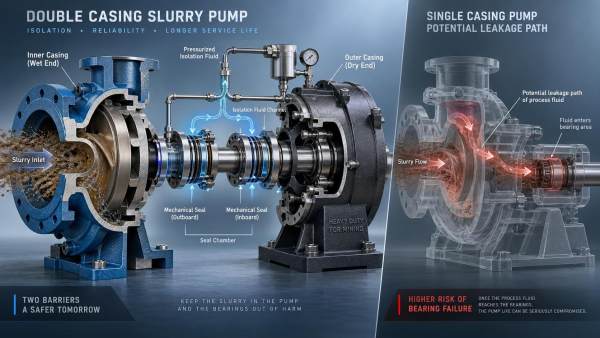
The core functional divergence lies in physical isolation. A single-housing slurry pump integrates the wet end (impeller, casing, liner) and dry end (bearing assembly, shaft, mechanical seal or packing gland) within one continuous cast or welded housing. This design simplifies manufacturing and reduces initial cost, but it forces a trade-off: any internal leakage—whether from worn throatbushes, eroded impeller clearances, or compromised seals—can migrate into the bearing chamber. Even small volumes of abrasive slurry crossing the seal barrier accelerate bearing wear, induce misalignment, and often trigger cascading failures. Field service logs from multiple copper and iron ore operations show that 68–74% of unplanned bearing replacements in single-housing units were preceded by detectable slurry ingress, confirmed via oil analysis or visual inspection of discolored grease.
A double-housing configuration physically separates those domains. The inner (wet) housing contains only fluid-handling components and is sealed at the shaft entry point using robust containment seals—typically dual mechanical seals with barrier fluid pressurization or gas-purged labyrinth arrangements. The outer (dry) housing fully encloses the bearing assembly, shaft, and drive coupling, remaining isolated from process fluid under normal operation. Critically, this separation isn’t just structural—it enables independent pressure management. Barrier fluid pressure in the inter-housing cavity is maintained slightly above suction pressure, creating a positive outward flow that prevents slurry ingress even during transient conditions like start-up surge or cavitation events.
That architecture directly affects reliability metrics—not abstractly, but in measurable service intervals. Independent maintenance audits across six dredging contractors operating in sandy-silt environments found median bearing life in double-housing units was 2.3× longer than matched single-housing models operating under identical duty cycles (same flow, head, solids concentration, and run hours). More telling was the consistency: coefficient of variation in bearing replacement intervals dropped from 41% (single-housing) to 17% (double-housing), indicating less sensitivity to minor installation variances or operator handling differences. Seal life followed a similar pattern—mechanical seal cartridges lasted on average 14 months in double-housing setups versus 5.7 months in single-housing equivalents, primarily because seal faces remained free of abrasive particle contamination.
Service access is where the comparison shifts from quantitative to procedural. On a single-housing pump, replacing a worn impeller or casing liner typically requires full disassembly of the wet end—including removal of the bearing housing, shaft, and coupling—because the shaft is inaccessible without breaking the dry-end integrity. That process routinely takes 6–10 hours for experienced crews, depending on bolting configuration and corrosion history. Crucially, each reassembly introduces risk: shaft runout tolerance must be re-verified; coupling alignment recalibrated; seal compression re-set. A 2022 cross-site survey of maintenance supervisors reported that 29% of post-repair vibration issues traced back to misalignment introduced during routine liner replacement on single-housing units.
Double-housing pumps decouple those tasks. The inner housing—with impeller, liners, and throatbush—is removable as a self-contained subassembly while the outer housing remains bolted to the baseplate, preserving shaft alignment and bearing preload. Removal involves loosening only the inner-to-outer housing bolts and lifting the wet-end module—often in under 90 minutes. No coupling disconnection, no bearing adjustment, no shaft realignment required. That modularity also changes spare parts strategy: operators stock complete inner housings pre-fitted with new liners and impellers, enabling true “swap-and-go” turnaround. One phosphate processing facility reduced scheduled liner change downtime from 14 hours to 2.5 hours after switching to double-housing units—without adding labor or overtime.
But the advantage isn’t unconditional. Double-housing designs carry higher initial capital cost—typically 25–40% more than equivalent single-housing models—and demand stricter attention to barrier fluid system integrity. A leak in the barrier fluid line or pressure regulator doesn’t cause immediate failure, but allows gradual dilution of the sealing interface, eventually compromising protection. That requires integration with plant monitoring systems—pressure transducers, flow switches, and fluid level alarms—that add complexity absent in simpler single-housing installations. For applications with intermittent duty cycles or infrequent maintenance oversight, that added layer of system dependency can offset reliability gains if not actively managed.
Thermal behavior also diverges. Single-housing units dissipate heat from the wet end directly through the shared casing wall, often aided by external cooling fins or jacketed housings. Double-housing units insulate the wet end thermally; heat generated by hydraulic losses and solids friction transfers more slowly to the outer housing, potentially elevating bearing temperatures if ambient conditions are extreme or ventilation is restricted. In hot-climate open-pit mines, thermal modeling shows bearing housing temperatures running 8–12°C higher in double-housing units under continuous high-head operation—necessitating derating or supplemental cooling in some cases.
Material selection further complicates direct comparison. Single-housing casings are commonly cast in high-chrome white iron (e.g., ASTM A532 Class III) for maximum abrasion resistance, but that same material is brittle and difficult to machine for precise sealing surfaces. Double-housing designs often use different alloys for inner and outer housings: the inner housing may retain high-chrome iron, while the outer housing uses ductile iron or stainless steel for better machinability and fatigue resistance around bolt holes and flanges. That material split improves long-term dimensional stability but introduces galvanic considerations if dissimilar metals contact in humid or saline environments.
Ultimately, the choice isn’t about which design is “better,” but which aligns with the operational reality of the application. Where maintenance labor is scarce, uptime penalties are steep, and process fluid is highly abrasive or corrosive, the double-housing architecture delivers measurable reductions in total cost of ownership—not through lower purchase price, but through predictable intervals, faster interventions, and fewer secondary failures. Where duty cycles are light, maintenance teams are highly skilled and available, and capital budgets are constrained, single-housing units remain technically sound—provided operators accept and plan for their inherent maintenance rhythm and failure mode profile.
Neither configuration eliminates the need for proper application engineering. Misapplied double-housing pumps—installed with inadequate barrier fluid supply, incorrect seal flush plans, or mismatched liner/impeller materials—fail faster than well-maintained single-housing units. The reliability advantage emerges only when the architecture’s requirements are met, not assumed. That makes specification accuracy—not just housing count—the decisive factor in long-term performance.
Related Information
 Sep 17, 2026Can zero leakage knife gate valves eliminate fugitive emissions in tailings transfer lines?Zero Leakage Knife Gate Valves—engineered to eliminate fugitive emissions in tailings transfer lines. Discover how true zero-leak design, proper installation & active maintenance deliver measurable safety and compliance gains.
- Sep 16, 2026When do wear resistant slurry pumps justify higher upfront cost over standard models?Wear Resistant Slurry Pumps deliver ROI in 6–18 months for high-erosion, continuous-duty applications—cut downtime, extend service life, and slash TCO.
- Sep 14, 2026How do high chrome alloy castings perform in abrasive mineral processing environments?High Chrome Alloy Castings deliver exceptional wear resistance in abrasive mineral processing—discover how microstructure, heat treatment, and real-world conditions drive true service life.
- Sep 17, 2026How does a double-housing slurry pump compare to single-housing models in reliability and service access?How does double housing slurry pump compare to single housing? Discover why double-housing designs deliver 2.3× longer bearing life, faster swaps, and lower TCO in abrasive applications.
Get a Quote
Please leave your information and email address, and we will contact you as soon as possible.