
ISO 5199 isn’t a checklist—it’s a stress test
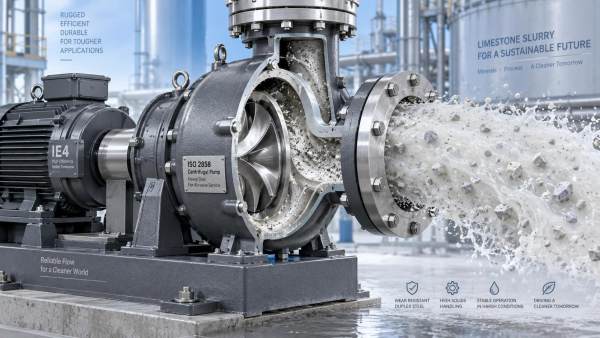
For technical evaluators sizing up flue gas desulfurization pumps, ISO 5199 isn’t just another certification stamp. It’s the only widely accepted international benchmark that forces manufacturers to demonstrate *how* a pump holds up—not just in clean water, but under real FGD conditions: 15–30% limestone slurry by weight, chloride concentrations often exceeding 20,000 ppm, pH swings between 4.5 and 6.5, and continuous operation for 8,000+ hours per year. Meeting ISO 5199 *on paper* is one thing. Meeting it *in service*, with abrasive solids constantly scouring seals, impellers, and casing liners? That’s where many pumps stop complying—and start failing.
What ISO 5199 actually demands—beyond dimensional tolerances
ISO 5199 defines three core compliance layers: dimensional interchangeability, material suitability, and performance verification. But in high-solids FGD applications, the real pressure falls on the last two.
Dimensionally, yes—flue gas desulfurization pumps must conform to ISO 5199’s shaft runout, bearing housing alignment, and coupling interface specs. But those tolerances were written for clear-liquid centrifugal service. When 25% solids pass through the same hydraulic passage, even minor deviations in volute geometry or impeller clearance amplify recirculation, erosion, and seal face loading. A pump built to nominal ISO 5199 dimensions may still suffer premature wear if its internal hydraulics weren’t validated *with solids present*.
Material selection is where ISO 5199 draws its sharpest line. Clause 6.3 explicitly requires “materials resistant to corrosion and abrasion appropriate to the service.” That phrase—“appropriate to the service”—isn’t optional wording. It means ASTM A890 Grade CD4MCu or UNS S32750 duplex stainless isn’t just recommended; it’s functionally necessary when handling wet limestone slurries with chlorides. Standard 316 stainless? Acceptable for short-term testing—but not for 5-year reliability in continuous high-solids duty. And yet, some suppliers list ISO 5199 compliance while specifying 304 housings or carbon steel shaft sleeves. That’s not noncompliance on paper—it’s misalignment between standard intent and operational reality.
The seal test most datasheets omit
ISO 5199 mandates mechanical seal testing—but only under clean-water conditions at rated flow and pressure. No slurry. No particulates. No thermal cycling. In practice, that means a pump can pass its ISO 5199 seal test while running flawlessly in the shop… then see seal life drop from 18 months to 4 weeks once installed in an absorber sump.
Why? Because high-solids FGD service introduces three seal killers no ISO 5199 test captures: (1) solids ingress into the seal chamber due to inadequate flush design or pressure differentials; (2) thermal shock from intermittent slurry temperature shifts (e.g., during startup or bypass); and (3) abrasive wear on secondary sealing surfaces—O-rings, bellows, or elastomer boots—that aren’t part of the primary seal face test.
So when evaluating flue gas desulfurization pumps, don’t just ask “Is it ISO 5199-compliant?” Ask instead: “Was the mechanical seal system validated with >15% limestone slurry at full operating temperature and flow—and what was the observed mean time between failures in field installations matching this spec?” That second question separates specification compliance from functional readiness.
Hydraulic stability matters more than peak efficiency
ISO 5199 doesn’t require extended low-flow or variable-speed testing. Yet in modern FGD systems, pumps routinely operate across 40–110% of BEP—due to load-following scrubbers, multiple absorber configurations, or turndown requirements. At low flow, recirculation increases. Solids settle. Vortexing intensifies. And that’s when impeller vane erosion accelerates, especially near the shroud-to-vane transition.
A pump meeting ISO 5199’s efficiency tolerance at BEP may still experience rapid degradation at 60% flow—if its hydraulic design wasn’t optimized for solids-handling stability, not just clean-water efficiency. Look for evidence beyond the curve sheet: Has the impeller profile been modified for reduced backflow? Is the volute throat area oversized to minimize velocity spikes? Are wear rings designed for easy replacement without rotor disassembly? These aren’t ISO 5199 requirements—but they’re prerequisites for sustained compliance in high-solids service.
Where “compliant” stops—and engineering judgment begins
There’s no ISO 5199 clause covering suction specific speed limits for abrasive slurries. No requirement for minimum NPSH margin above vapor pressure when handling aerated slurry. No test protocol for evaluating bearing life under combined radial load and vibration from slurry-induced cavitation.
That’s why technical evaluation can’t end at the certificate. It must extend into application context: What’s the actual solids distribution—not just average %—and how does particle size affect erosion patterns? Is the pump expected to handle occasional grit bypass from upstream screens? How frequently will it cycle between standby and full load?
These variables don’t invalidate ISO 5199. They simply reveal its role: a baseline, not a guarantee. True reliability emerges only when ISO 5199’s structural and material requirements are paired with application-specific engineering—seal selection based on slurry analysis, not water tests; material upgrades justified by chloride mapping, not generic spec sheets; and hydraulic validation conducted where it counts: in the field, with real slurry, over real time.
So before signing off on a flue gas desulfurization pump specification, confirm whether the ISO 5199 claim reflects dimensional conformity—or proven behavior in continuous high-solids operation. The difference isn’t academic. It’s measured in maintenance intervals, spare parts budgets, and forced outage risk.
 Sep 19, 2026Do flue gas desulfurization pumps meet ISO 5199 requirements for continuous high-solids operation?Flue Gas Desulfurization Pumps: Do they truly meet ISO 5199 for real-world high-solids FGD service—or just on paper? Discover the critical gaps between compliance and reliability.
- Sep 18, 2026What failure modes distinguish industrial knife gate valves from low-cost alternatives?Knife Gate Valves: Discover how industrial-grade knife gate valves fail *differently*—and why design integrity, not just price, defines true reliability.
- Sep 17, 2026Can zero leakage knife gate valves eliminate fugitive emissions in tailings transfer lines?Zero Leakage Knife Gate Valves—engineered to eliminate fugitive emissions in tailings transfer lines. Discover how true zero-leak design, proper installation & active maintenance deliver measurable safety and compliance gains.
- Sep 16, 2026When do wear resistant slurry pumps justify higher upfront cost over standard models?Wear Resistant Slurry Pumps deliver ROI in 6–18 months for high-erosion, continuous-duty applications—cut downtime, extend service life, and slash TCO.

Get a Quote
Please leave your information and email address, and we will contact you as soon as possible.