
How corrosion resistant pumps perform in high-chloride seawater desalination plants
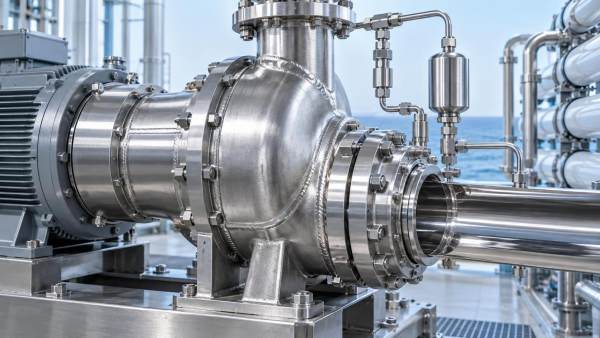
In high-chloride seawater desalination plants, material degradation poses one of the most critical operational challenges—making corrosion resistant pumps not just a preference, but a necessity. These pumps must withstand aggressive saline environments, extreme pressure cycles, and continuous exposure to biofouling agents—without compromising efficiency or service life. For technical evaluators assessing long-term system reliability, understanding how advanced metallurgy (e.g., super duplex stainless steels, titanium alloys) and precision sealing technologies enhance pump resilience is essential. This article examines real-world performance metrics, failure mode analysis, and selection criteria that directly impact CAPEX, OPEX, and uptime in modern desalination infrastructure.
It’s not about “resistance”—it’s about *localized* resistance
You’ll often see datasheets touting “excellent corrosion resistance” for pumps rated for seawater duty. That’s technically true—but dangerously incomplete. In desalination, chloride-induced pitting and crevice corrosion don’t fail uniformly. They strike where flow stagnates: under gasket interfaces, behind impeller vanes, inside seal chambers, or at weld heat-affected zones. A pump built with standard 316 stainless steel may survive six months in low-salinity brackish feed—but in Red Sea or Persian Gulf intake water (often >42,000 ppm Cl⁻), it can develop micro-pits within weeks. Those pits grow into stress-corrosion cracks under cyclic pressure from high-pressure RO stages. That’s why specifying “corrosion resistant pumps” isn’t enough—you need to specify *where* and *how* resistance is engineered.
Metallurgy matters—but only if it’s applied correctly
Super duplex stainless steels (e.g., UNS S32750, S32760) are now the baseline for critical service in modern plants—not because they’re universally superior, but because their PREN (Pitting Resistance Equivalent Number) >40 reliably outperforms standard duplex in high-chloride, low-pH brine streams. Titanium Grade 2 or Grade 7 (Ti-0.15Pd) goes further: immune to chloride stress cracking, even at elevated temperatures and pH swings during cleaning cycles. But here’s what’s rarely discussed upfront: titanium’s mechanical strength is lower than super duplex. So while its corrosion behavior is predictable, its fatigue life under pulsating flow (especially in booster or energy recovery turbine feed services) depends heavily on casing design and impeller balancing—not just the alloy itself. We’ve seen cases where Ti Grade 2 pumps failed prematurely not from corrosion, but from resonant vibration induced by mismatched piping stiffness. Metallurgy sets the ceiling—but geometry and installation set the actual operating envelope.
Sealing isn’t an afterthought—it’s the first line of defense
Most failures in high-chloride service don’t start at the casing—they begin at the seal. Conventional single-cartridge mechanical seals, even with Hastelloy C-276 faces, struggle when exposed to suspended solids in raw seawater or precipitated CaSO₄ during antiscalant overdosing. The real issue isn’t seal face wear—it’s secondary seal swelling, elastomer hydrolysis, or spring corrosion in the bellows. Double-ended, externally pressurized gas seals (using nitrogen buffer gas) eliminate wetted elastomers entirely and isolate the seal chamber from process fluid. But they add complexity—and require strict control of buffer gas dew point and pressure differential. In practice, the most reliable installations we’ve reviewed use hybrid approaches: dual unpressurized seals with ceramic/metallic faces and fluorocarbon secondary seals—paired with upstream filtration down to 100 µm—not as a luxury, but as a non-negotiable prerequisite for seal longevity.
Performance decay isn’t linear—and it’s rarely visible
Unlike thermal or electrical systems, corrosion-driven performance loss in pumps doesn’t show up clearly on trending curves. Head drop might be masked by variable-speed drive compensation. Efficiency loss may be absorbed by increased motor amperage—until insulation breakdown occurs. What *does* trend early? Vibration harmonics above 3× RPM—indicating developing imbalance from uneven pitting on impeller shrouds. Or gradual rise in seal flush temperature—hinting at reduced thermal conductivity in corroded seal chamber walls. These aren’t “failure warnings.” They’re evidence that localized attack has already progressed beyond initiation phase. That’s why predictive maintenance programs in mature desalination plants don’t rely solely on runtime hours—they correlate vibration spectra, seal flush data, and periodic endoscopic inspection of wetted surfaces at known risk points (like diffuser vanes or volute throat).
Don’t overlook the “soft” factors: fabrication, QA, and traceability
Two pumps with identical spec sheets—same material grade, same seal type, same hydraulic design—can behave very differently in service. Why? Because corrosion resistance depends as much on manufacturing execution as on nominal chemistry. Weld interpass temperature control during super duplex fabrication directly affects ferrite/austenite balance—and thus resistance to sigma phase embrittlement. Heat tint removal post-welding isn’t cosmetic; residual oxides create galvanic cells. And surface finish matters: Ra <0.8 µm on wetted surfaces reduces biofilm adhesion and minimizes crevice depth for chloride accumulation. If your supplier can’t provide full material test reports (MTRs) with mill heat numbers traceable to each casting, or can’t document post-weld acid pickling and passivation per ASTM A967, you’re buying uncertainty—not hardware.
What to watch for during technical evaluation
When reviewing proposals, avoid checklist-based scoring. Instead, ask three pointed questions:
- Where exactly are the critical crevices—and how was their geometry validated against ISO 21873-2 (seawater corrosion testing for rotating equipment)?
- What evidence exists that the seal support system accounts for both particulate loading *and* transient pH shifts during CIP cycles?
- Can you share third-party inspection records—not just for the pump, but for the specific batch of castings used in the last five units delivered to similar salinity conditions?
If answers are generic or refer only to lab tests (not field-validated performance), treat the proposal as preliminary—not final.
Final note: Corrosion resistant pumps buy time—not immunity
No pump, however well-engineered, is immune to chloride attack over decades of operation. The goal isn’t zero corrosion—it’s controlled, predictable degradation that aligns with planned maintenance intervals and spares strategy. That means selecting corrosion resistant pumps isn’t just about initial spec compliance. It’s about understanding how each design choice—from metallurgical heat treatment to seal cavity geometry—shifts the failure timeline, reshapes the maintenance curve, and ultimately defines the true cost of ownership across 15–20 years of service. If your evaluation stops at material grade or pressure rating, you’re likely optimizing for the first year—not the plant’s lifetime.
 Sep 20, 2026Why sewage treatment pump selection matters more than everLearn how to select sewage treatment pumps by treatment stage, flow rate, total head, solids handling and material compatibility. Compare submersible, self-priming and progressive cavity pumps, assess lifecycle cost, and verify JB/T 14955-2025 energy efficiency compliance.
 Sep 21, 2026How corrosion resistant pumps perform in high-chloride seawater desalination plantsCorrosion resistant pumps engineered for high-chloride seawater desalination—delivering reliability, extended service life, and lower TCO in harsh RO environments.
- Sep 19, 2026Do flue gas desulfurization pumps meet ISO 5199 requirements for continuous high-solids operation?Flue Gas Desulfurization Pumps: Do they truly meet ISO 5199 for real-world high-solids FGD service—or just on paper? Discover the critical gaps between compliance and reliability.
- Sep 18, 2026What failure modes distinguish industrial knife gate valves from low-cost alternatives?Knife Gate Valves: Discover how industrial-grade knife gate valves fail *differently*—and why design integrity, not just price, defines true reliability.

Get a Quote
Please leave your information and email address, and we will contact you as soon as possible.