
When Does Thick Slurry Need a Positive Displacement Pump?
A thick slurry needs a positive displacement pump when its viscosity, yield stress, or required discharge pressure prevents a centrifugal pump from delivering the required flow reliably and efficiently. The strongest reasons to switch are poor centrifugal performance with viscous material, high resistance at a relatively low flow rate, and a process that requires steady delivery as backpressure changes. Solids concentration alone does not establish that need.
The choice also has a second condition: the positive displacement pump must suit the slurry’s particles, chemistry, and suction conditions. A pump that develops sufficient pressure can still fail through abrasive wear, blocked valves, damaged elastomers, or incomplete filling. Selection therefore starts with the slurry’s behavior throughout the operating cycle, including startup after a shutdown.
Is there a solids percentage or viscosity that determines the switch?
There is no universal cutoff. Solids percentage describes composition, but it does not fully describe resistance to flow. A slurry containing coarse, freely moving particles can remain relatively easy to pump. A mixture with a lower solids concentration can develop substantial yield stress when fine particles form an interacting structure.
The concentration basis matters as well. Weight percentage and volume percentage are not interchangeable. Dense mineral particles can produce a high weight percentage without occupying the same volume as lighter solids at that weight percentage. Particle shape, size distribution, and the amount of liquid available between particles further change how the mixture behaves.
Viscosity requires similar care. For a Newtonian liquid, viscosity at a stated temperature provides a useful starting point. Many thick slurries are non-Newtonian: their apparent viscosity changes with shear rate, and some also change with time under shear. A single viscosity value without temperature, shear rate, and test conditions provides a weak basis for pump selection.
The practical crossover occurs when the centrifugal pump’s corrected performance no longer meets the actual duty with acceptable efficiency, reliability, and wear. That assessment requires slurry properties and a system resistance calculation, supported by representative testing where the material is difficult to characterize.
Which operating conditions favor positive displacement?
Viscosity causes unacceptable centrifugal performance losses
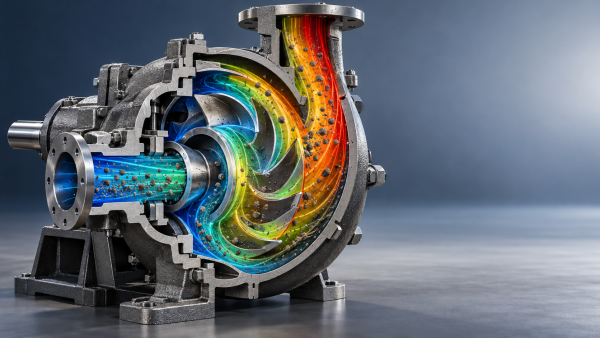
A centrifugal pump transfers energy through its impeller and the surrounding flow passages. As viscosity increases, internal friction rises, efficiency falls, and the available flow and head change. Water performance curves cannot be applied directly to a thick slurry. Even standard viscosity corrections require care when the material has yield stress or complex rheology.
Positive displacement pumps move a defined volume through repeated displacement cycles. This makes several designs suitable for viscous materials, provided their chambers fill properly. However, theoretical displacement is not guaranteed delivery: internal leakage, entrained gas, and incomplete filling reduce actual output.
The distinction becomes useful when a centrifugal pump needs excessive speed or power to maintain production flow, or when its usable operating range becomes too narrow as slurry consistency varies. A positive displacement design deserves evaluation if it can meet the same duty at an appropriate speed with manageable wear.
The slurry must overcome yield stress or high pipeline resistance
A material with yield stress requires sufficient applied stress before sustained flow begins. After a shutdown, settled solids or structural rebuilding can increase the pressure needed to restart the line. The running duty and the restart duty therefore need separate evaluation.
A positive displacement pump is often suitable for delivering a modest flow against substantial resistance, such as a long pipeline, an elevated discharge, or a pressure filtration process. Its discharge pressure rises in response to system resistance, within the limits of its drive and pressure-containing components.
That ability does not make a plugged pipeline an acceptable operating condition. Pressure protection must act before the pump, piping, or downstream equipment exceeds its allowable pressure. If a settled bed cannot be safely remobilized, flushing or clearing the line remains necessary.
Flow must remain relatively stable as backpressure changes
A centrifugal pump’s flow shifts along its performance curve as system resistance changes. This can be troublesome when feeding equipment whose resistance increases during operation, such as a filter press. A positive displacement pump generally provides a more direct relationship between operating speed and delivered volume.
Actual flow still varies with pump wear, differential pressure, slurry properties, and inlet filling. Tight dosing requirements may therefore need flow measurement and feedback control. Reciprocating designs also create pulsation, which must be assessed where the receiving process needs smooth delivery.
When should a centrifugal slurry pump remain the preferred option?
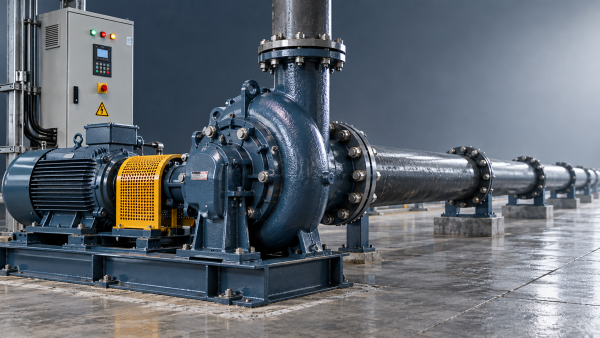
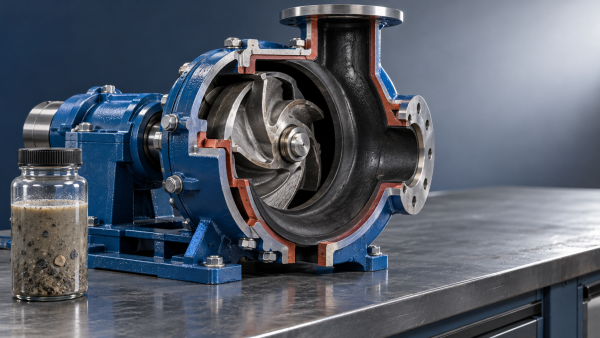
A centrifugal slurry pump remains a strong candidate when the material stays mobile, the required flow is high, and the pressure duty falls within a practical operating range. Designs with suitable solids passages and replaceable wear components are widely used for abrasive suspensions. Changing pump principles solely because the slurry looks thick can introduce unnecessary complexity.
Low flow from an existing centrifugal installation also needs diagnosis before replacement. Air entering the suction line, inadequate submergence, a worn impeller, a restricted inlet, incorrect rotation, or an unexpected discharge restriction can all resemble a viscosity problem. A positive displacement pump will not correct these installation faults automatically.
Compare the measured operating point with a credible slurry performance estimate. Useful observations include suction and discharge pressure, actual flow, speed, power draw, slurry temperature, and concentration. If performance deteriorates mainly after standing, settling or structural rebuilding deserves investigation before assuming that running viscosity is the only cause.
Which positive displacement design suits the slurry?
The term “positive displacement” covers pumps with very different particle tolerance, pressure capability, and wear behavior. Selection must continue beyond choosing the pumping principle.
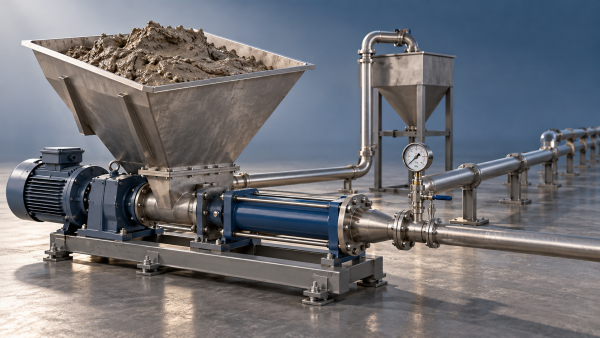
- Progressive cavity pumps suit many viscous slurries and pastes and provide relatively smooth delivery. Rotor and stator wear, elastomer compatibility, particle size, and dry-running protection require attention. Materials that do not flow readily into the inlet may need a hopper and assisted feed.
- Hose pumps confine the slurry inside a flexible hose, keeping it away from shaft seals and pumping mechanisms. Hose fatigue, chemical compatibility, allowable pressure, inlet recovery, and pulsation determine suitability.
- Piston diaphragm pumps merit consideration for demanding pressure duties with abrasive slurry. Their valves and passages must accommodate the solids, while the hydraulic system and diaphragm require appropriate monitoring and maintenance.
- Air-operated double-diaphragm pumps handle varied transfer duties, but compressed-air demand, pulsation, and flow reduction as discharge pressure rises need evaluation. Their performance should not be treated as equivalent to fixed-speed rotary displacement.
Rotary lobe and other displacement designs also serve selected slurry applications. Close internal clearances, however, can make hard particles and abrasive fines decisive limitations. Maximum particle passage alone is insufficient: angularity, hardness, fibers, and agglomerates affect jamming and wear differently.
Can the slurry actually reach and fill the pump?
Suction conditions frequently decide whether a proposed change succeeds. A positive displacement pump can develop high discharge pressure while receiving too little material at its inlet. Thick slurry loses pressure through suction piping, bends, valves, and strainers, and some pastes barely move under gravity.
A short, generously sized inlet with few restrictions supports filling. Flooded suction or a feed hopper can be necessary, especially for materials with substantial yield stress. Increasing speed to compensate for inadequate delivery can worsen starvation because each chamber has less time to fill. The result can include irregular flow, cavitation, heating, and accelerated damage.
Available inlet pressure must be compared with the selected pump’s requirements at the intended speed and slurry condition. A water-based suction assessment alone is inadequate when viscous losses are large. Entrained gas also occupies pumping volume and can interfere with valve operation or compress during delivery.
Settling introduces another constraint. Flow must remain sufficient to transport the solids where deposition is possible, while pump speed must stay compatible with inlet filling and wear limits. Selecting a very low flow merely because a displacement pump can produce it can leave the pipeline vulnerable to blockage.
What must be confirmed before changing pump type?
A useful selection basis includes the normal duty and the difficult operating states. Record the required flow range, discharge pressure, elevation change, piping arrangement, and downstream equipment resistance. Describe the slurry using solids concentration and its basis, particle size distribution, largest credible agglomerate, abrasiveness, temperature, chemistry, and settling behavior.
For non-Newtonian material, a flow curve across relevant shear rates is more useful than one viscosity reading. If the slurry rebuilds structure while stationary, include a representative rest period in testing. Samples taken after dilution or prolonged mixing can understate the startup load.
Compare candidate pumps at the same delivered flow and differential pressure, including drive losses and any auxiliary energy. For abrasive duty, ask how wear changes flow, power, and maintenance intervals. A pump that performs well when new can lose its advantage as clearances increase or elastomer components deteriorate.
The installation also needs protection suited to displacement pumping. A blocked discharge requires a properly sized pressure relief arrangement and an appropriate shutdown strategy. The relief path must accommodate the slurry without becoming obstructed; repeated recirculation can heat or alter the material. Dry-running protection, pressure measurement, and pulsation control should match the selected design.
Where uncertainty remains, a representative pumping trial should reproduce suction conditions, backpressure, and restart behavior closely enough to test the disputed assumptions. Successful steady running with freshly mixed slurry does not establish that the same pump will restart a settled line or handle the most concentrated batch.
A positive displacement pump becomes the stronger choice when it can deliver the required slurry flow through the full pressure and consistency range, with adequate inlet filling and acceptable particle handling. Those conditions establish a defensible selection far more clearly than a visual judgment of thickness.
Related Information
 Oct 28, 2026
Is CFD Analysis Worth the Cost for a Custom Slurry Pump?
Is CFD analysis worth paying for when buying a custom slurry pump? Discover when simulation can reduce wear risks, guide design choices, and justify its cost before you buy.- Oct 28, 2026
When Does Thick Slurry Need a Positive Displacement Pump?
When does thick slurry need a positive displacement pump instead of a centrifugal pump? Discover how viscosity, pressure, and flow stability guide selection—and avoid costly pumping mistakes. - Oct 27, 2026
Can Slowing a Slurry Pump Reduce Wear Without Causing Settling?
Will slowing down my slurry pump reduce wear without causing settling? Learn how to verify minimum transport flow, check pump limits, and test lower speeds to cut wear safely. - Oct 27, 2026
Is pH Enough to Select a Corrosion-Resistant Slurry Pump Material?
Is slurry pH enough to choose a corrosion-resistant pump material? Learn how chemistry, temperature, and abrasion shape selection, and discover practical steps to avoid costly pump failures.

{item.title}
Get a Quote
Please leave your information and email address, and we will contact you as soon as possible.