
Is CFD Analysis Worth the Cost for a Custom Slurry Pump?
Paying for CFD analysis can be worthwhile when a custom slurry pump introduces hydraulic uncertainty that could lead to expensive wear, excessive power demand, or unreliable operation. Its value is strongest when the results can change the design before manufacturing. A simulation that only illustrates an already finalized pump offers much less purchasing value.
For a pump closely derived from a proven design, handling a well-characterized slurry within an established operating range, additional CFD may be difficult to justify. The buying decision should turn on three questions: what uncertainty needs resolving, whether the proposed model can resolve it credibly, and what financial consequence follows if the design is wrong.
When does a custom slurry pump justify the extra analysis?
The word “custom” does not establish a need for CFD. A pump may require a special mounting arrangement, connection, or material specification while retaining a proven hydraulic design. Those changes can require engineering checks without creating a strong case for a new flow simulation.
The case becomes stronger when customization changes the impeller, casing, internal passages, inlet arrangement, or operating conditions beyond the available performance evidence. Changes to passage size, for example, can affect solids handling, internal velocities, and hydraulic performance together. CFD can help assess those trade-offs before the geometry becomes expensive to revise.
Several situations deserve particular attention:
- An unfamiliar slurry: particle size distribution, solids concentration, or flow behavior differs substantially from the service used to establish the pump’s performance.
- A broad operating range: the pump must handle meaningful changes in flow, speed, slurry concentration, or system resistance.
- A costly failure consequence: premature wear or unstable performance would interrupt production, require difficult maintenance, or affect other equipment.
- A constrained hydraulic design: installation limits or solids passage requirements force compromises that need evaluation before manufacture.
Even in these situations, the study needs a specific decision to support. “Compare two impeller geometries for particle impact near the leading edge” is a useful objective. “Optimize the pump” leaves too much room for a technically elaborate report with little effect on the purchase.
For replacement equipment, existing operating evidence can sharpen that objective. Uneven casing wear, repeated impeller damage, measured power demand, and the conditions surrounding failures can help identify what needs investigation. CFD becomes more useful when it addresses a documented problem rather than attempting to explain every possible source of poor service life.
What can CFD tell you—and how much should you trust it?
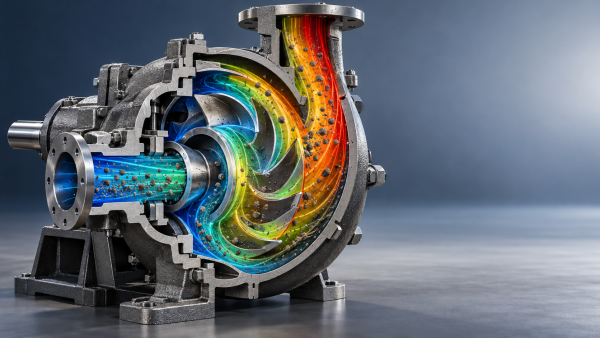
CFD calculates flow behavior within a modeled geometry under specified conditions. For a slurry pump, it can help compare pressure distributions, recirculation, local velocities, solids distribution, and particle impact patterns. These results can explain why two designs with similar predicted head and efficiency might expose particular components to different wear conditions.
Its strongest purchasing role is often comparison. If several feasible designs are evaluated using consistent assumptions, the analysis can help identify a design that reduces an undesirable flow feature while retaining the required duty. Confidence in the absolute performance prediction still depends on the model and its validation.
Can it predict wear life?
A wear plot can identify areas that deserve attention, but converting that plot into a dependable replacement interval requires much more evidence. Erosion depends on particle properties, impact conditions, component materials, and the wear model used. Corrosion, manufacturing variation, and the way internal geometry changes during service can also affect the outcome.
Without suitable calibration, a claim that one design has lower predicted erosion may be more defensible than a claim that its liner will last a specific number of operating hours. Ask whether the wear results represent relative comparisons or validated estimates of material loss. Those are different deliverables with different value.
A design change that reduces one local erosion peak also deserves a wider check. It may move particle impacts elsewhere, reduce hydraulic efficiency, or narrow a passage needed for the actual solids. The report should explain the compromise and show whether the modified design still satisfies the operating requirements.
Will it establish efficiency or cavitation performance?
CFD can support efficiency comparisons, but the modeled fluid must represent the service well enough for the conclusion being drawn. Water-based analysis may provide a useful hydraulic baseline. It does not, by itself, establish slurry efficiency when solids loading or non-Newtonian behavior materially changes the flow.
Cavitation analysis requires similarly careful interpretation. Local low-pressure regions can indicate a concern, but cavitation behavior depends on inlet conditions, fluid properties, and the modeling approach. Air entrainment and solids can complicate the picture further. Any contractual suction-performance requirement needs an agreed verification method; a pressure contour alone is insufficient evidence.
Some reliability questions also sit outside the proposed flow model. Seal failures, shaft deflection, bearing life, and structural vibration may require separate mechanical assessment. Paying for CFD will not resolve those issues unless the study supplies relevant loads or conditions to an appropriate additional analysis.
What makes a CFD proposal worth paying for?
A credible proposal should connect the operating data, modeling method, design alternatives, and verification plan. Buyers do not need to select the solver themselves, but they should be able to understand what the analysis represents and which conclusions it can support.
Start with the slurry description. A single average particle size or nominal concentration may conceal the conditions that cause trouble. Depending on the application, useful inputs include the particle size distribution, particle density and shape, solids concentration, carrier-liquid properties, temperature, and measured rheology. Concentration must be clearly identified as a mass or volume basis.
If those properties vary, ask the supplier to evaluate a justified range. An apparently precise result based on one uncertain input can be less useful than a comparison showing whether the preferred design remains acceptable across plausible conditions. Gathering a representative slurry sample or improving operating measurements may therefore deserve funding before a more elaborate simulation.
The required modeling approach follows from the question. Tracking particles in a liquid flow can help investigate trajectories and impacts, but the treatment must account appropriately for the influence of solids on the flow. Dense slurries, strong particle interactions, and non-Newtonian behavior may require different assumptions. Greater model complexity adds value only when it captures behavior that matters to the decision.
The proposal should answer the following questions plainly:
- Which operating cases will be evaluated? Include the required duty and relevant sustained or recurring departures from it.
- What geometry is included? Inlet features, clearances, and other simplifications should be disclosed where they could affect the conclusion.
- How will numerical reliability be checked? Convergence, conservation checks, and sensitivity to mesh resolution should support the reported results. Transient studies also need suitable time-step checks.
- What evidence supports the model? Relevant pump tests, slurry performance data, or documented wear patterns can provide a basis for comparison.
- What design changes and reruns are included? A diagnosis has limited value if the quoted scope ends before a revised design can be assessed.
Validation deserves particular scrutiny. Agreement with a water test can support confidence in part of the hydraulic prediction while leaving slurry-specific wear predictions uncertain. Similarly, experience with a related pump is useful only to the extent that its geometry and operating conditions are relevant. The supplier should explain where the evidence applies and where judgment remains necessary.
Ask for deliverables that support a decision: the baseline, alternatives considered, assumptions, performance comparisons, identified risks, and recommended geometry changes. Color contours can help explain a result, but buyers also need quantities and reasoning that connect those images to the specified duty.
The commercial scope should distinguish analysis from performance responsibility. Establish whether CFD is already part of the supplier’s normal design process, what the additional fee purchases, and which commitments will be demonstrated by testing. Paying separately for simulation should produce a clear engineering deliverable without blurring responsibility for the finished pump.
How should you compare the fee with the potential return?
The relevant comparison is the total incremental cost of the study against the losses it could realistically help avoid. Alongside the quoted fee, consider slurry characterization, engineering review, design iterations, and any effect on the delivery schedule. Then identify which costs are actually sensitive to the hydraulic design under review.
For an abrasive service, those may include wear parts, maintenance labor, and production interruptions. For a continuously operating pump, electricity may also be material. Where access is difficult, extending the interval between interventions can have value beyond the price of replacement components.
Keep the estimate tied to the evidence. An energy calculation should reflect the expected duty profile, operating hours, electricity tariff, and a defensible change in input power. A predicted efficiency improvement at one operating point cannot establish annual savings for a pump that spends much of its time elsewhere.
Wear-related savings need equal care. If the model supports only a relative erosion comparison, build the business case around a range of possible maintenance benefits. Avoid treating a predicted reduction in an erosion indicator as an equivalent percentage increase in component life.
A useful break-even question is: how much improvement would recover the full analysis cost? That might be one avoided maintenance intervention, a modest reduction in annual energy use, or avoiding a redesign after commissioning. The next question is whether the proposed study can credibly influence that outcome. A severe failure consequence alone does not make an unsuitable model valuable.
Staging the work can make the decision easier. Begin with a review of duty data, available test evidence, and the design uncertainty. Proceed to targeted CFD if that review identifies a question simulation can answer. Reserve further iterations for changes that show a meaningful benefit. This gives the buyer useful stopping points before committing to a large analysis program.
When is the better decision to skip CFD?
Additional CFD is less compelling when a supplier can demonstrate relevant performance from the same hydraulic design in comparable service, the operating range is well understood, and the consequences of a mismatch are manageable. Testing, better slurry characterization, or improved site measurements may then provide more useful evidence for the same budget.
It is also reasonable to defer simulation when the process conditions remain unsettled. A detailed model of an uncertain duty can create confidence that the inputs do not justify. Resolving the expected flow range, solids loading, or suction conditions may change the selection before internal geometry needs optimization.
Before approving the fee, ask the supplier to complete one sentence: “This study will help us choose between these options, using these acceptance criteria.” A clear answer connects the expense to a purchasing decision. If the answer remains vague, tighten the scope first. CFD earns its place in a custom slurry pump purchase when it produces evidence strong enough to change the design, the operating limits, or the decision to proceed.
Related Information
 Oct 28, 2026
Is CFD Analysis Worth the Cost for a Custom Slurry Pump?
Is CFD analysis worth paying for when buying a custom slurry pump? Discover when simulation can reduce wear risks, guide design choices, and justify its cost before you buy.- Oct 28, 2026
When Does Thick Slurry Need a Positive Displacement Pump?
When does thick slurry need a positive displacement pump instead of a centrifugal pump? Discover how viscosity, pressure, and flow stability guide selection—and avoid costly pumping mistakes. - Oct 27, 2026
Can Slowing a Slurry Pump Reduce Wear Without Causing Settling?
Will slowing down my slurry pump reduce wear without causing settling? Learn how to verify minimum transport flow, check pump limits, and test lower speeds to cut wear safely. - Oct 27, 2026
Is pH Enough to Select a Corrosion-Resistant Slurry Pump Material?
Is slurry pH enough to choose a corrosion-resistant pump material? Learn how chemistry, temperature, and abrasion shape selection, and discover practical steps to avoid costly pump failures.

{item.title}
Get a Quote
Please leave your information and email address, and we will contact you as soon as possible.