
How to Choose Materials for a Chemical Slurry Pump
The best material for a chemical slurry pump depends on which threat will limit its life first: corrosion from the liquid, erosion from the solids, or a combination of the two. A hard metal may resist abrasion yet fail quickly in an aggressive chemical. An elastomer liner may handle fine particles well but be unsuitable for a hot solvent or sharp, coarse solids.
Start chemical slurry pump material selection by identifying the liquid chemistry and the nature of the particles, then compare materials for each wetted component under the full range of operating conditions. The aim is to find a combination that offers a predictable service life without creating unacceptable leakage, maintenance or replacement costs.
Compare the main material options
The table provides a starting point for discussion, not a compatibility approval. Each material family includes grades or formulations with different properties, and pump design can change how a material performs.
These options are not necessarily alternatives for the whole pump. A lined casing, a wear-resistant impeller and a chemically compatible seal may form a better combination than one material used throughout. The practical constraint is whether the pump design offers those combinations and supports them at the required operating conditions.
Define the slurry before choosing a material
A material recommendation is only as useful as the duty description behind it. “Acid slurry” or “abrasive wastewater” leaves too many unanswered questions. The supplier needs enough information to assess both the liquid and the solids, including conditions during cleaning, startup and process upsets.
Identify the liquid and its changing chemistry
Provide the chemical constituents and their concentration ranges, operating and maximum temperatures, and pH where relevant. Include chlorides, oxidizing agents, solvents and other constituents that could affect compatibility. A mixture may behave differently from any one ingredient considered in isolation, while dilution or a temperature increase can change the rate or form of attack.
Do not treat pH as a complete compatibility test. Two liquids with similar pH can attack an alloy or elastomer differently because of their composition. Similarly, an alloy described as “stainless” can still suffer pitting, crevice corrosion or other localized damage in an unsuitable environment. Ask for the specific alloy grade and its suitability for the stated chemistry, rather than accepting the family name alone.
Cleaning chemicals deserve the same scrutiny as the process slurry. A liner that tolerates normal operation may swell, soften or lose strength when exposed to a cleaning solvent or a higher-temperature wash. Record how long the pump is exposed to each condition, not just the normal operating point.
Describe the particles that cause wear
For the solids, specify concentration, particle size distribution, shape and hardness where known. Large or angular particles can produce a different wear pattern from fine, rounded solids. Concentration also matters, but it does not describe the duty on its own: a lower concentration of hard, sharp particles can still cause severe localized wear.
Particle behavior affects material choice as well. Solids may settle during shutdown, accumulate in low-flow areas or pass through the pump as irregular clusters. These conditions can increase starting loads, cause blockage or concentrate wear. A pump moving a consistent fine slurry may therefore need a different construction from one handling the same nominal solids percentage with occasional coarse debris.
Flow rate, differential pressure, speed and operating duration complete the picture. Local velocity and turbulence influence erosion, while operation away from the pump’s suitable range can create recirculation and uneven wear. Material selection cannot fully compensate for a pump that is hydraulically unsuitable for the duty.
Choose between hard metals, alloys and linings
Hard metals: strong against wear, conditional against corrosion
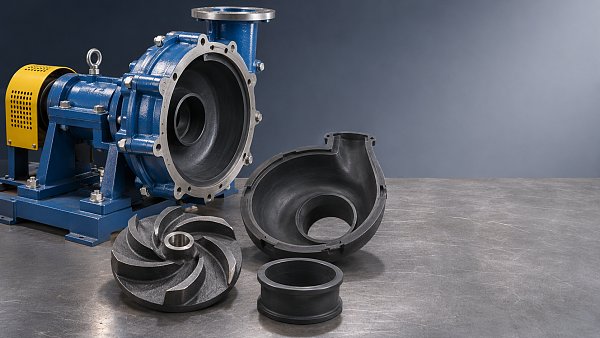
High-chromium white iron is a candidate when abrasive solids dominate and the chemical environment is compatible with the chosen grade. It can be used for impellers and other wear parts in slurry pump designs built around replaceable components. Its hardness, however, does not make it a universal solution for chemical service.
If the liquid attacks the metal, corrosion can remove or weaken the surface while particles continue to erode it. The resulting combined damage may be more severe than either mechanism considered separately. Brittle hard-metal components also require attention where large particles, impact or rapid temperature changes are possible.
For a hard-metal proposal, ask which grade is offered for each wetted part and how its chemical suitability was assessed at the maximum temperature and concentration. If the duty varies, the short but aggressive operating period may determine the component life.
Corrosion-resistant alloys: start with chemistry, then check wear
Stainless steels and more highly alloyed metals can be appropriate when corrosion controls the decision. The selected grade must suit the actual liquid, including chloride content, oxidizing conditions and temperature. Fabrication and narrow gaps can also affect susceptibility to localized corrosion, so compatibility depends on the component and its service environment as well as its nominal composition.
The compromise is that a corrosion-resistant alloy may wear faster than a hard metal or a suitable liner when exposed to abrasive particles. A higher alloy content should not be assumed to improve erosion resistance. If an alloy impeller is proposed for a corrosive slurry, compare the expected maintenance burden with other compatible constructions, especially at the impeller inlet and discharge edges where wear can concentrate.
Elastomers and fluoropolymers: compatibility is formulation-specific
Rubber-lined designs can be attractive for compatible slurries containing fine solids. The resilient surface may resist wear well, and replaceable liners can make maintenance more manageable. Their performance depends on the particular rubber compound and on particle size, shape, temperature and chemical exposure. Sharp solids, coarse debris or high-velocity zones can damage a lining that otherwise appears well suited to the liquid.
Other elastomers offer different chemical and temperature properties, but the most chemically resistant formulation is not automatically the best wear material. Obtain the exact compound designation and check both liquid compatibility and slurry duty. Consider what happens if the liner swells, hardens, separates from its backing or is cut: damage in one area can expose the supporting structure to the process fluid.
Fluoropolymer-lined pumps can be useful for aggressive chemicals, provided the complete lining system is suitable for the pressure, temperature and solids involved. A lining that resists chemical attack may still be vulnerable to mechanical wear or damage at edges and joints. Check the manufacturer’s limits for the assembled pump and the practical consequences of a damaged lining, including whether individual parts can be replaced.
Evaluate the complete wetted assembly
The casing and impeller usually receive most of the attention, but they are only part of the material decision. Depending on the pump design, the liquid may contact a shaft or shaft sleeve, wear plates, fasteners, gaskets, seals and flush connections. A compatible casing cannot protect an exposed seal component or gasket that fails in the same liquid.
Seal selection is particularly dependent on both chemistry and solids. Mechanical seal faces, elastomeric secondary seals and metal parts each need review. Abrasive particles can also damage seal faces or interfere with seal operation. Where a flush or barrier system is proposed, check the fluid’s compatibility, availability and effect on the process, as well as the consequences of losing the supply.
Pay attention to interfaces. A lined component may have exposed edges or joints; a corrosion-resistant component can contain crevices; dissimilar metals may require assessment where electrical contact and a conductive liquid are present. Ask which surfaces are wetted in normal operation and during maintenance or upset conditions, then review each material against those exposures.
Coatings and ceramic inserts can protect selected wear zones, but their effectiveness depends on coverage, attachment and resistance to impact. Once a coating is breached, the underlying material may be exposed. For any localized protection, understand how wear will be detected and whether the protected part can be repaired or must be replaced.
Compare proposals by failure risk and maintenance cost
A lower purchase price can be misleading if the construction requires frequent liner changes, damages expensive mating parts or causes unplanned shutdowns. A more expensive alloy or lined design can also be poor value if it solves corrosion while leaving abrasion uncontrolled. Compare the expected failure mechanisms and maintenance work for each proposal before comparing prices.
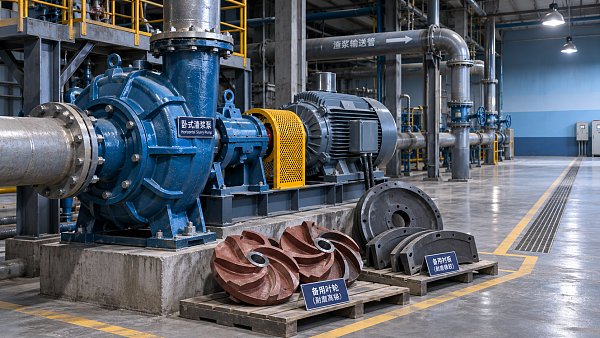
Ask suppliers to state the material grade or formulation for every wetted component, the operating limits of the complete assembly, and the conditions used for their recommendation. A useful proposal also identifies replaceable wear parts, inspection points, spare-part availability and any special installation or maintenance requirements. If service life is estimated, the assumptions about chemistry, solids and operating hours should be visible.
Where the duty is uncertain or unusually severe, a compatibility review may need to be supported by laboratory testing, a representative trial or inspection of materials already exposed to the same process. A trial should define what will be measured and when the parts will be inspected; an undamaged appearance after a short run does not establish long-term resistance.
Before making the final choice, compare the likely consequences of each credible failure. If a worn liner can be replaced during a planned shutdown, a sacrificial lining may be practical. If loss of containment would interrupt a critical process, the integrity of the wetted assembly and the ability to detect damage may carry more weight than the initial cost of the pump.
Related Information
 Nov 28, 2026
How to Select a Slurry Pump for a Cement Plant
Simplify cement plant slurry pump selection with practical guidance on pump types, sizing, wear materials, and system design to reduce downtime.- Nov 28, 2026
How to Choose Materials for a Chemical Slurry Pump
Chemical slurry pump material selection made easier: compare metals, alloys and linings to reduce corrosion, wear and maintenance costs. - Nov 27, 2026
What Affects Ash Slurry Pump Prices for Power Plants?
Power plant ash slurry pump price depends on materials, flow, head, and operating conditions. Learn how to compare quotes and reduce lifetime costs. - Nov 27, 2026
How to Evaluate Steel Mill Scale Slurry Pump Suppliers
Compare steel mill scale slurry pump suppliers with confidence. Learn how to assess pump selection, wear resistance, maintenance, support, and lifecycle costs.

{item.title}
Get a Quote
Please leave your information and email address, and we will contact you as soon as possible.