
Selecting a heavy-duty slurry pump for iron ore mining starts with the slurry, not the pump catalog. A unit that performs well on a lower-density transfer duty can fail quickly when moved to cyclone feed, tailings, concentrate transport, or a line carrying coarse, angular particles. Iron ore applications combine abrasion, variable solids concentration, long operating hours, and process interruptions that can expose weak points in hydraulics, liners, bearings, and sealing systems.
The best choice is rarely the largest pump or the model with the highest published head. It is the pump whose hydraulic range, wetted materials, drive arrangement, and maintenance design match a defined duty point and the realistic operating envelope around it. Before comparing suppliers, mine operators should establish what is actually moving through the pipe, how the duty changes, and what a stoppage costs at that location in the plant.
Start with the duty, not the nominal pipe size
A heavy-duty slurry pump for iron ore mining should be selected from process data that describes the solids as well as the liquid. Flow rate and required head remain essential, but they do not explain the wear environment on their own. Two lines with the same pipe diameter and nominal flow can place very different demands on a pump if one transports fine magnetite concentrate and the other handles coarse primary mill discharge.
The minimum duty definition should include:
- Required flow rate, including normal, minimum, and maximum operating conditions.
- Total dynamic head, with static lift, friction loss, fittings, valves, cyclones, and downstream pressure requirements included.
- Slurry density or solids concentration by weight and, where available, by volume.
- Particle size distribution, particularly the upper particle size and the proportion of coarse material.
- Particle shape and hardness, because sharp or hard particles can accelerate wear beyond what density alone suggests.
- Slurry temperature, pH, chlorides, and other chemistry that may affect corrosion resistance or elastomer suitability.
- Expected operating profile: continuous duty, campaign operation, intermittent transfer, standby service, or frequent starts and stops.
Process data should reflect variation, not only the design average. Ore properties can shift between benches, stockpiles, and blends. Thickener performance can change slurry density. A blocked screen, altered grind size, or a revised pipeline route may move the pump away from its intended condition. Selecting only for one clean design point often creates a unit that is efficient on paper but unstable when the process moves.
For this reason, pump curves should be reviewed against a duty window. The selected impeller diameter and speed should allow the pump to cover expected flow and head changes without consistently operating at either extreme of its curve. A pump running too far left can experience recirculation, vibration, heat generation, and accelerated internal wear. One forced too far right may lack head margin, draw excessive power, or suffer poor operating control.
Match the wet-end materials to the wear mechanism
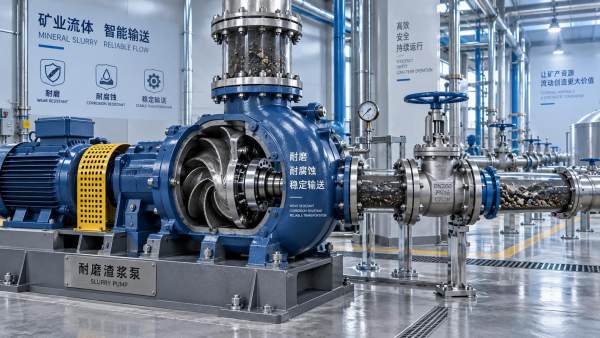
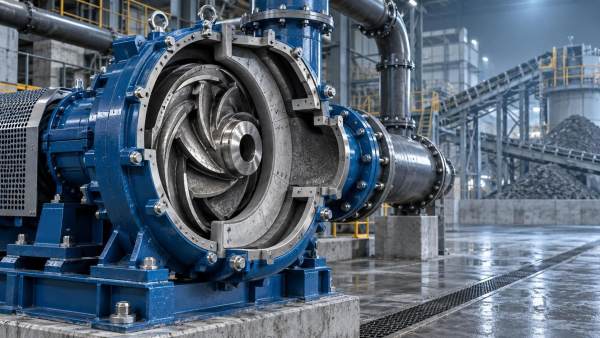
Iron ore slurry is often described simply as abrasive, but abrasion is not one uniform condition. Fine, dense concentrate can create persistent sliding wear. Coarse particles can cause impact damage, especially around impeller leading edges, throatbushes, volutes, and suction liners. When chemistry is aggressive as well, corrosion and erosion can act together and shorten component life.
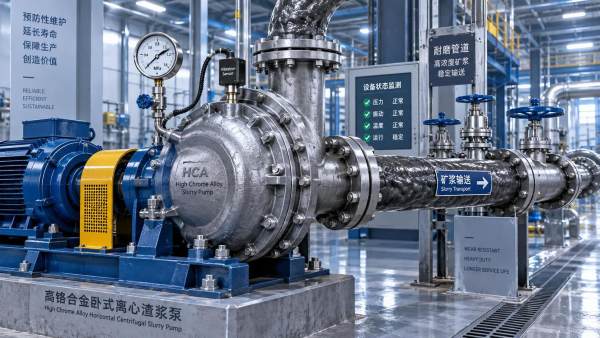
High-chrome white iron is widely used for severe abrasive duties because it provides strong resistance to hard-particle wear. It is often a sound choice for coarse or dense iron ore slurry where impact and abrasion dominate. However, hardness alone should not decide the specification. Brittle materials can be vulnerable where unusually large tramp material, severe impact, or mechanical upset is possible. The expected particle size, particle hardness, and consequences of occasional oversize material need to be considered together.
Elastomer-lined wet ends can be effective in selected fine-particle services, particularly where a resilient surface helps absorb particle impact. Their suitability becomes more limited as particle size, sharpness, temperature, or chemical exposure increases. Rubber is not a universal lower-cost substitute for metal. In a coarse ore duty, a liner that looks economical at purchase can become a frequent maintenance item and introduce unacceptable availability risk.
Some services require a material decision that accounts for both corrosion and abrasion. Water quality, reagent carryover, pH adjustment, and chloride exposure may matter in beneficiation circuits, tailings systems, or return-water-related duties. In these cases, material selection should be based on the actual slurry environment and compatible operating history where available, rather than on a generic statement that a material is “corrosion resistant.”
The practical question for procurement is not which alloy lasts longest in isolation. It is which wet-end configuration provides predictable life, acceptable replacement cost, and manageable maintenance intervals for that position in the circuit. A high-wear pump located ahead of a critical downstream process may justify a more robust material and a spare rotating assembly. A non-critical transfer duty may support a different lifecycle trade-off.
Do not overlook hydraulic design and operating speed
Wear life is influenced by pump size and speed as much as by liner material. A smaller pump running at high speed can sometimes meet the required duty, but higher peripheral velocity generally increases the severity of wear. A larger pump operating more slowly may have a higher purchase cost and require more installation space, yet it can offer longer wet-end life and more stable operation in abrasive service.
This does not mean that larger is always better. Oversizing can produce its own problems if normal operation falls too far below the pump’s preferred range. The objective is to choose a hydraulic size that reaches the required head and flow at a reasonable speed while retaining room for controlled process variation.
When reviewing proposals, compare more than the headline efficiency figure. Efficiency is meaningful only at the relevant slurry duty and impeller condition. Ask how the duty point sits on the curve, what impeller diameter is proposed, what speed is required, and how performance is expected to change as components wear. A pump with a slightly lower initial efficiency may be the stronger operational choice if it maintains a usable duty point longer between planned maintenance events.
Suction conditions can determine whether a pump is reliable
A robust wet end cannot compensate for poor suction conditions. Iron ore slurry systems often involve flooded sumps, variable liquid levels, long suction lines, strainers, bends, or feed conditions affected by upstream equipment. Each of these can influence net positive suction head available, air entrainment, solids settling, and the consistency of flow into the impeller eye.
Cavitation in slurry service is especially damaging because it can combine pressure-related damage with abrasive attack. It may appear as noise, vibration, declining performance, or unexpectedly rapid damage near the impeller inlet. Air entrainment can also reduce capacity, disturb pump control, and make a stable operating point difficult to maintain.
Good selection work includes the suction pipework and sump geometry. Short, direct suction runs are generally easier to manage than long lines with unnecessary fittings. The line should avoid high points that trap air and low-velocity sections where solids can settle. A sump must provide enough submergence and residence time for stable intake conditions without creating zones where coarse particles accumulate and periodically surge into the pump.
There is a common temptation to solve a suction problem by choosing a larger pump. That can worsen the issue if the larger unit draws more aggressively from an inadequately designed sump or line. Confirming available suction head under the least favorable operating condition is more useful than relying on nominal static level alone.
Seal selection should follow the process consequences of leakage
Shaft sealing is often treated as a secondary option after the pump model is selected. In iron ore mining, it deserves earlier attention because the appropriate seal arrangement depends on water availability, solids concentration, operating pressure, and the consequences of external leakage or dilution.
A packed gland remains a practical arrangement for many slurry duties. It is serviceable and familiar to maintenance teams, but it requires flush water and adjustment. Excessive tightening can damage packing and sleeves; insufficient control can lead to unacceptable leakage. The water used for gland service also enters the system, which may matter where water balance or downstream density is tightly controlled.
Expeller or centrifugal seal arrangements can reduce or eliminate the need for gland water during normal operation, depending on the duty and pressure conditions. They are not automatically suitable for every installation. Their performance depends on the pump operating as intended, and they may not be appropriate when the pump must tolerate prolonged low-speed operation, reverse rotation, certain suction conditions, or high static pressure while stopped.
Mechanical seals may be justified in applications where containment, limited dilution, or local operating conditions demand them. They require careful selection, compatible flush plans where needed, and disciplined installation. Treating a mechanical seal as a universal upgrade can lead to a costly arrangement that is less tolerant of severe solids than the service requires.
Plan for maintenance while selecting the pump
A pump can have the correct curve and materials yet still be a poor selection if routine maintenance is difficult at the installation point. Iron ore operations often depend on pumps that work in parallel or feed critical equipment, so the time required to inspect or replace wear parts directly affects plant availability.
Selection should consider access to the wet end, lifting routes, space for a cartridge or rotating assembly, availability of isolation valves, and whether the pump can be removed without dismantling surrounding pipework. A back pull-out or similar maintenance-friendly configuration may reduce downtime, but only when the site layout supports its use. There must be physical clearance to perform the intended maintenance task safely.
Interchangeability also matters. If several pumps serve related duties, standardizing where the hydraulic requirements allow can reduce spare-parts inventory and simplify training. Standardization should not force an unsuitable pump into a high-wear position, but it can be valuable when two duties genuinely fall within the same operating range.
Ask suppliers to identify the expected replaceable wear components, the adjustment method for impeller clearance, bearing lubrication requirements, and the parts that normally determine overhaul timing. The purpose is not to demand an artificial guarantee of component life. Wear depends heavily on ore and operation. The aim is to understand which parts will be consumed, how quickly their condition can be assessed, and whether maintenance can be planned before performance falls below process requirements.
Use lifecycle cost to compare competing proposals
Purchase price is visible at the beginning of the project, while the cost of wear, energy, downtime, labor, water, and spare parts appears over the operating life. For a critical heavy-duty slurry pump, the lower-priced proposal may not be lower cost if it needs higher speed, lacks hydraulic margin, uses less suitable liners, or requires frequent disruptive maintenance.
A useful comparison separates the proposals into operational questions: Can each pump meet the full duty window? What power will it absorb at normal and adverse conditions? Which components are expected to wear first? How long does a wet-end change take in the planned installation? Is a spare assembly required? Does the seal arrangement consume process water or create a leakage-management burden?
These questions produce a more credible decision than attempting to assign a precise universal cost-per-tonne figure before the ore and operating practice are known. They also expose proposals that look similar at a catalog level but differ materially in speed, material configuration, serviceability, and operating tolerance.
For iron ore mining, the right pump selection is a disciplined match between slurry behavior and equipment capability. Define the real duty envelope, select materials for the dominant wear mechanism, avoid excessive speed, verify suction conditions, and make maintenance access part of the equipment specification. That approach gives the operation a better basis for reliable pumping than choosing by pipe size, maximum head, or initial price alone.
 Sep 15, 2026When custom slurry pumps make sense for unusual duty conditionsCustom Slurry Pumps deliver reliable performance in abrasive, corrosive, high-temperature, and variable-duty applications. Learn when customization reduces downtime and lifecycle costs.
- Sep 14, 2026How slurry pumping solutions can lower unplanned downtimeSlurry Pumping Solutions help manufacturers cut unplanned downtime through smarter pump selection, condition monitoring, wear control, and lifecycle-focused maintenance strategies.
- Sep 13, 2026When mining slurry pumps need thicker wear-resistant componentsMining Slurry Pumps need thicker wear-resistant components when wear rates disrupt planned maintenance. Learn how to select liners, impellers, and materials for reliable uptime.
- Sep 12, 2026What coal washing pumps need to handle dense magnetite mediaCoal Washing Pumps for dense magnetite media: learn how hydraulic design, wear materials, sealing, and suction stability protect pressure, uptime, and coal recovery.

Get a Quote
Please leave your information and email address, and we will contact you as soon as possible.