
How to Check Aftermarket Slurry Pump Parts for Fit
To check whether an aftermarket slurry pump part will fit, identify the exact pump configuration, compare the replacement with the original part’s critical dimensions and interfaces, and verify the material and operating requirements. A matching part number is a useful starting point, but it does not establish that every mounting surface, internal clearance or material specification is correct.
The level of checking depends on the part. A casing bolt may be straightforward to compare; an impeller, liner or shaft sleeve can affect clearances, sealing and pump performance even when it appears to install correctly. Before ordering, establish which measurements matter for that component and agree with the supplier on how compatibility will be confirmed.
Start with the pump as installed
Collect the pump manufacturer, model, size and serial number from the nameplate or equipment records. Add the part name, original part number and quantity required. If the pump has a documented build number, arrangement code or bill of materials, include those as well.
These details help narrow the search, but the pump’s present configuration deserves equal attention. A unit may have been rebuilt, modified or fitted with a different liner, impeller or seal arrangement during its service life. The part currently installed may therefore differ from the one shown in an older general catalog.
Check maintenance records for previous changes and look for markings on the removed component. Record whether the pump uses the relevant metal or elastomer-lined configuration, the seal arrangement and any shaft or mounting details that affect the part being replaced. For handed components, note the orientation as defined in the applicable drawings; do not rely on a description such as “left side” without stating the viewing direction.
If the nameplate is missing or unreadable, use the strongest combination of evidence available: equipment drawings, purchase records, old part markings, photographs and measurements. Ask the supplier to identify any assumptions in its proposed match. A visually similar pump is not enough to establish interchangeability.
Use part numbers to find a candidate, then check the interfaces
An original part number and an aftermarket cross-reference can identify a likely replacement. They may not reveal revisions, differences between pump configurations or limitations attached to a particular listing. Ask for a drawing or dimensional specification for the exact part being offered, including its revision where applicable, and compare it with the requirements of your pump.
Focus first on the surfaces and features that locate, connect or seal the part. Overall size matters, but a small mismatch at an interface can prevent assembly or leave the component incorrectly positioned.
- Impeller: Check the shaft connection, thread or other attachment details, impeller diameter, axial dimensions and the geometry relevant to the fitted liners and adjustment method. Confirm the intended direction of rotation and compatibility with the pump’s seal and shaft arrangement.
- Wear liners and casing parts: Compare the mating faces, locating features, bolt pattern, port geometry and sealing surfaces. Check that the proposed liner matches the casing and adjoining liners in the installed arrangement.
- Shaft sleeves: Verify the bore, length, outside diameters, shoulders, sealing locations and any drive or locking features. The sleeve must suit both the shaft and the seal arrangement.
- Gaskets and seals: Check the inside and outside dimensions, profile, thickness and material. For a seal assembly, confirm the complete installation envelope and shaft or sleeve interface rather than comparing one ring in isolation.
For bolted parts, compare the number and diameter of holes, their spacing and the thickness or depth available for fasteners. For threaded connections, confirm the thread form, diameter, pitch, handedness and engagement requirements. A connection that starts by hand should not be assumed correct: forcing a mismatched thread can damage the shaft or replacement part.
Record dimensions with units and identify where each measurement was taken. A bolt-circle diameter, for example, is different from the distance between two adjacent holes. Where a drawing specifies a datum or measuring method, use it so that both parties are comparing the same features.
Measure the old part carefully
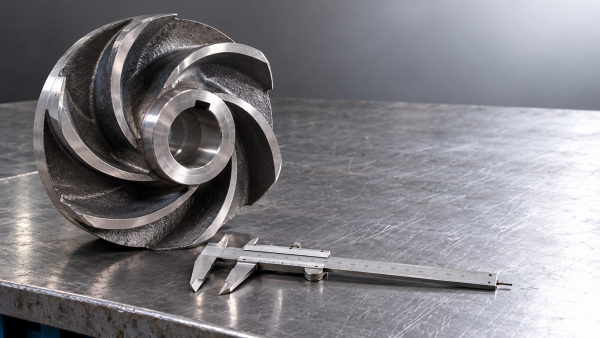
The removed part is valuable evidence, especially when records are incomplete. Clean it sufficiently to expose locating faces, threads and markings, then photograph it from several angles alongside a scale. Measure undamaged mounting and sealing features with suitable instruments, and keep the readings with the pump identification.
Do not treat every dimension on a worn slurry pump component as its original dimension. Wear can reduce an impeller’s outside diameter, alter vane profiles, erode liner surfaces and distort edges. Corrosion, damage during removal or a previous repair can also make the old part a misleading reference. Compare worn features against an original drawing or an unworn mating component wherever possible.
It is equally important to distinguish a deliberate clearance from a missing dimension. An impeller may need an adjustable running clearance relative to a liner; the correct value and adjustment procedure depend on the pump design and should come from the applicable instructions. Measuring the gap on a worn assembly does not establish the correct setting for a new part.
When measurements and records disagree, stop before choosing whichever value is more convenient. Establish whether the discrepancy comes from wear, a revision, a prior modification or the wrong reference drawing. If the supplier cannot explain how its proposed part accommodates the difference, compatibility remains unresolved.
Check the material against the duty
Dimensional fit is only one part of suitability. A replacement impeller or liner may assemble correctly and still perform poorly if its material is unsuited to the slurry or operating conditions. Compare the proposed material specification with the original requirement and the actual duty, including the solids, fluid chemistry, temperature and operating conditions.
For example, abrasion, impact and corrosion can place different demands on a wear material. A change between a metal and an elastomer may also involve differences in component design or mating parts. Do not assume that two materials are interchangeable because they are offered for the same broad pump family, or that a generic description such as “abrasion resistant” establishes equivalence.
Ask for the material grade or specification and any documentation needed by your maintenance or quality process. For elastomer parts, also confirm compatibility with the pumped liquid and operating temperature. Where the original material is unknown, describe the duty and request a recommendation with its limitations stated; avoid treating an unidentified old part as proof that the same material is appropriate.
Confirm the complete assembly, not just one component
Some parts are dependent on the condition and specification of their neighbors. A new impeller must work with the shaft, liners and adjustment arrangement. A sleeve must fit the shaft and provide the correct surface and position for the seal. A liner must seat against the casing and align with adjacent components. A part can match one interface while creating a problem at another.
Check whether the proposed replacement requires particular mating parts, fasteners, gaskets or installation hardware. This matters when only one item in an assembly is being replaced: a revised component may be suitable when supplied as a set but incompatible with an older adjoining part. Ask the supplier to state any such restrictions in writing.
Also inspect the mating equipment. A replacement part cannot correct a damaged shaft thread, worn locating surface, distorted casing or deteriorated seal housing. If those surfaces are outside the applicable repair limits, even a correctly manufactured part may not seat or seal as intended.
Give the supplier a clear compatibility package
Send the identification and measurements together rather than relying on a part number alone. A useful request includes:
- Pump manufacturer, model, size, serial number and any build or arrangement code.
- Original part name and number, plus the quantity required.
- The installed configuration, including liner, impeller and seal details relevant to the part.
- Drawings or labeled measurements of critical interfaces, with units and measurement locations.
- Photographs of the part, markings and relevant mating surfaces.
- The required material specification or a description of the slurry and operating conditions.
- Details of known modifications, previous replacements or discrepancies in the records.
Request the supplier’s proposed part number, drawing, material specification and confirmation of the pump configuration covered. Ask it to identify any dimensions it has not checked and any required companion parts. Keep that response with the purchase record so that the receiving and maintenance teams know what was agreed.
If the supplier provides only a broad model cross-reference, ask for enough interface information to evaluate the specific part. The amount of detail needed should reflect the consequence of a mismatch: a critical rotating or pressure-containing component warrants a more rigorous review than a readily checked standard fastener.
Inspect before installation and verify during assembly
On receipt, compare the supplied part and its identification against the agreed drawing and purchase specification. Check for transport damage, incorrect material documentation, missing hardware and obvious dimensional discrepancies. Measure critical interfaces before taking the pump out of service if the replacement is available in advance.
During installation, follow the applicable pump and component instructions, including isolation, lifting, torque and adjustment procedures. Verify that mating faces are clean, the component seats as intended and required clearances can be set. Do not remove material, force alignment or alter a part simply to make it assemble without an approved engineering assessment.
After assembly, complete the prescribed checks for free rotation, sealing and commissioning. A successful installation is evidence that the interfaces work together, but operating behavior still needs attention: leakage, unusual vibration, rubbing or a change in performance calls for investigation rather than an assumption that the new part is suitable because it physically fitted.
If the pump identification, critical dimensions or material requirements cannot be reconciled, hold the order or installation until the discrepancy is resolved. The most useful compatibility confirmation identifies the exact configuration and interfaces checked, along with any conditions attached to the replacement.
Related Information
 Nov 02, 2026
Is Stainless Steel Worth the Extra Cost for Chloride Slurry?
Is stainless steel worth the extra cost for chloride-bearing slurry? Compare grades, wear risks, and lifecycle costs to find the best-value solution.- Nov 02, 2026
How to Check Aftermarket Slurry Pump Parts for Fit
How can I check whether aftermarket slurry pump parts will fit my existing pump? Discover the key dimensions, interfaces and materials to verify before ordering. - Nov 01, 2026
What Dimensions Should You Confirm for a Custom Knife Gate Valve?
What dimensions must I confirm before ordering a custom knife gate valve? Explore flange, port, face-to-face and clearance requirements to avoid costly fit issues. - Nov 01, 2026
Can a Chinese Slurry Pump Replace an Imported One in a Steel Plant?
Can a Chinese-made slurry pump replace an imported unit in a steel plant? Discover how to assess performance, fit, wear and costs before making the switch.


{item.title}
Get a Quote
Please leave your information and email address, and we will contact you as soon as possible.