
Start With the Material, Not the Pump Catalog
A dredging pump for a river sediment removal project should be selected from the sediment and hydraulic conditions of the site, then matched to the dredging method. Starting with a pump model or a nominal discharge size often produces an expensive mismatch: the pump may move plenty of water but leave dense deposits behind, suffer rapid wet-end wear, or fail to maintain discharge through a long pipeline.
River sediment is rarely uniform. A reach may contain soft silt near the bank, fine sand in a depositional area, coarse sand or gravel near a channel constriction, and debris around structures. The material also changes after rainfall, gate releases, or upstream works. A pump sized for loose, water-rich silt can lose performance quickly when it encounters compacted sand. Conversely, a unit selected solely for occasional coarse particles may consume unnecessary power and create excessive turbulence in a fine-sediment cleanup operation.
Before choosing equipment, define the material in operational terms:
- Expected particle-size range, including the largest particles that may enter the intake.
- Whether the deposit is loose, consolidated, layered, or mixed with organic matter.
- Likely solids concentration at the pump inlet, rather than the concentration assumed in a laboratory sample.
- Abrasiveness of the solids, especially where angular sand, crushed aggregate, shell fragments, or mineral-rich sediment are present.
- Presence of trash: roots, plastic, timber, wire, fabric, stones, or construction debris can govern intake and cutter design.
- Whether sediment properties vary substantially along the dredging route.
Particle size alone does not describe pumpability. Fine clay can be difficult even when individual particles are small, because cohesive material may resist breakup and form dense plugs. Organic sludge can wrap around intake components or create unstable feeding conditions. Coarse sand may flow readily but steadily erode impellers, liners, and suction-side components. The practical question is whether the material can be delivered to the pump as a stable slurry and kept moving until it reaches the discharge point.
This distinction affects the dredging arrangement. Loose sediment may be removed with a plain suction head, sometimes aided by water jets or agitation. Compacted or cohesive deposits often need a cutter head, auger, excavator support, or another mechanical loosening method. A more powerful pump cannot reliably compensate for a poor material-feeding arrangement. If the suction intake is starved, blocked, or repeatedly exposed to air, output will remain inconsistent regardless of the pump's published capacity.
Calculate the Actual Pipeline Duty
For river work, the pump must overcome more than the vertical lift from the riverbed to the discharge area. The full duty point includes suction conditions, static elevation, friction through the discharge line, bends, valves, reducers, hose sections, floating pipeline movement, and the resistance created by the slurry itself. This is why a pump that appears adequate on water-performance curves may be inadequate once installed on a working dredge.
The starting inputs should be the desired solids production rate, expected slurry concentration, pipeline diameter, total discharge length, elevation change, and discharge destination. A project depositing sediment near the shoreline has a different hydraulic requirement from one pumping material across a floodplain, into a dewatering area, or to a remote confined disposal site. Pipeline routing matters as much as total length. Multiple sharp bends, undersized flexible hose, frequent diameter transitions, and poorly supported floating line all add losses and make operation less stable.
Flow rate and head should be considered together. High flow at low head may look attractive, but if pipeline velocity drops below the level needed to keep the expected solids in suspension, heavier particles can settle out. A settled pipeline is not just a delay. Restarting may require flushing, mechanical intervention, or partial line removal, and the pump can be damaged if it is forced against a blockage.
At the other extreme, selecting a much larger pump to create a large safety margin can lead to unnecessary fuel or electrical demand, accelerated wear, difficult discharge-area management, and erosion in vulnerable parts of the line. Excess velocity can also make it harder to control where fine sediment settles at the placement site. The target is a workable transport velocity for the material, not the highest possible water flow.
Read Pump Curves as Slurry Curves
Published pump curves are commonly based on water. Slurry operation changes the effective head, efficiency, power requirement, and wear rate. As solids become denser or more abrasive, the pump delivers less head and may require more input power than a water-only reading suggests. A selection process should therefore account for the intended slurry density and the largest expected solids, rather than treating the water curve as a final operating guarantee.
The desired duty point should sit in a stable part of the pump's operating range. Continuous operation far from the best-efficiency region can increase vibration, recirculation, heat, and component loading. In dredging service, some variation is unavoidable because concentration and pipeline resistance change during the shift. The useful design margin is one that accommodates those changes without moving the pump into chronic low-flow or overloaded operation.
Ask for a complete system view before approving a pump package. It should identify the predicted operating point, expected power draw, discharge pipe assumptions, slurry basis, suction arrangement, and limits on particle passage. If a proposed duty relies on ideal water conditions while the project includes long-distance slurry transport, the comparison is incomplete.
Choose the Configuration Around the River Access Method
The pump type has to fit the way the equipment will reach the sediment. The same river may favor different configurations at different points because access, water depth, bank stability, current, and working-space restrictions change.
A cutter suction dredge is generally suited to sustained removal where a floating platform can work safely and the deposit requires controlled excavation. The cutter helps feed material into the suction line and can be effective for sand, silt, and moderately consolidated deposits when properly matched to the pump and ladder geometry. Its limitations include mobilization requirements, access constraints, and the need to manage anchors, navigation, and pipeline routing.
An excavator-mounted dredge pump or submersible slurry pump can be practical for localized removal, irregular shorelines, basins, bridge approaches, and sites where a conventional dredge cannot position easily. The excavator provides reach and selective digging, while the pump transports loosened slurry. This arrangement can work well for targeted work, though throughput depends heavily on how consistently the excavator feeds the pump and how much water is entrained during digging.
Trailer-mounted or skid-mounted pump systems can be appropriate for shallow access points or temporary dewatering and sediment-transfer tasks. They may simplify transport, but suction lift, priming, intake submergence, and hose handling become central concerns. Surface-mounted pumps are more exposed to suction limitations than submerged units. Long suction lines and poor intake conditions can reduce output before the slurry reaches the pump.
For projects with fluctuating water levels or restricted bank access, a modular arrangement may be more useful than a single large unit. The decision should be based on productive hours at the river, not only rated capacity. A high-capacity dredge that cannot work through changing water conditions, cannot be mobilized to the site, or requires frequent repositioning may deliver less useful production than a smaller, better-matched system.
Wet-End Materials Determine Whether Performance Will Last
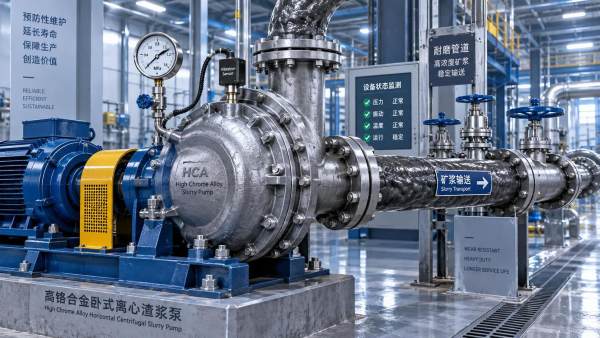
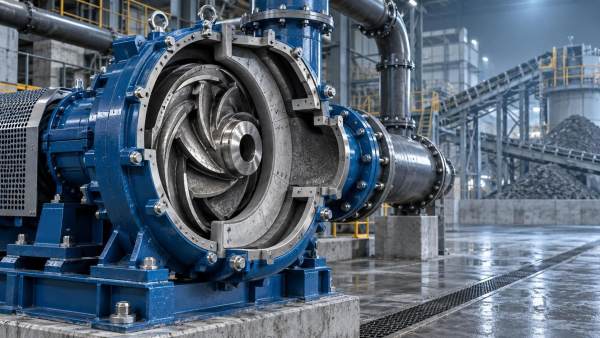
Dredging pumps operate in a wear environment. The wet end, including the impeller, casing or liner, throatbush, suction liner, and seal-related components, should be evaluated as a wear system rather than as a list of individual parts. Abrasive sediment will gradually change clearances and hydraulic geometry. As that happens, head and efficiency fall, power behavior may shift, and the pump can no longer maintain pipeline velocity.
High-chrome wear alloys are commonly considered for abrasive sand and mineral solids because they provide strong resistance to erosive wear. Their suitability still depends on impact conditions, particle shape, and maintenance practices. Elastomer-lined components may be useful in some fine-slurry duties, but sharp or large particles can limit their application. Stainless materials are often discussed for corrosion resistance, yet corrosion resistance alone does not make a material suitable for severe abrasion. The material decision should reflect the dominant damage mechanism at the site.
Seal selection also deserves attention. Mechanical seals, packing arrangements, expellers, and gland-water systems have different maintenance and water-use implications. River projects may have limited access to clean service water, making a seal arrangement that depends on continuous, reliable flushing less attractive. No seal arrangement is maintenance-free when slurry conditions are variable, but the service plan should match the available operator skill, spare-parts access, and downtime tolerance.
Inspectability matters. A pump with replaceable liners and accessible wet-end components can be easier to maintain than a design requiring extensive disassembly for routine wear checks. That advantage is meaningful only when the project can stock the necessary spares and personnel can measure wear before it becomes a failure. For a short campaign, it may be enough to carry critical wear parts. For longer river maintenance programs, planned inspection intervals and component-life tracking become part of the pump selection.
Do Not Treat Power and Controls as Secondary Details
A pump package must have enough power for the expected slurry duty, including transient conditions such as startup, concentration spikes, cutter loading, and line clearing. Engine or motor rating should not be compared casually with the pump's nominal requirement. The installed drive, transmission or gearbox, variable-speed control, cooling arrangement, and available site power all affect whether the pump can operate continuously at the intended point.
Variable speed is particularly valuable where sediment conditions or discharge distances change. It allows operators to adjust flow to maintain transport while avoiding prolonged operation at an inefficient or overloaded condition. It does not eliminate the need for correct pump sizing, but it gives the system a useful operating range when river conditions are less predictable than the design assumption.
Instrumentation should support decisions that operators can make during the job. At a minimum, monitoring flow, discharge pressure, pump speed, engine or motor load, and slurry density where practical helps distinguish normal variation from developing problems. A pressure rise combined with falling flow may indicate a line restriction. Falling pressure and unstable flow can point to air ingress, poor suction feeding, or loss of pump prime. Without operating data, crews tend to respond after production has already fallen or a blockage has formed.
Test the Proposed System Against the Difficult Part of the Job
Selection should be tested against the hardest credible condition, not the most favorable material sample. This does not require assuming that every hour will contain large debris or dense gravel. It means identifying the conditions likely to interrupt production: a compacted layer, a longer-than-planned discharge route, falling river level, abrasive sand lens, or a section where trash accumulation is likely.
A practical review with a pump supplier, contractor, or engineering team should answer several direct questions:
- What slurry concentration and particle range form the basis of the proposed performance?
- What pipeline length, diameter, elevation, and fitting losses are included in the calculation?
- How will the sediment be loosened and fed to the pump?
- What is the expected operating range, and what happens if concentration rises?
- Which wet-end components are expected to wear first, and how are they inspected or replaced?
- What protection is provided against oversize solids, trash, dry running, blockage, and drive overload?
- Can the system be mobilized, launched, positioned, and serviced within the site's access and water-level constraints?
The best choice is often a balanced package rather than the largest dredging pump offered. It combines a pump curve suited to the slurry pipeline, an intake that can feed the actual deposit, materials that tolerate the expected wear, and controls that keep the operation within a stable range. When those elements are aligned, sediment removal becomes easier to plan, easier to maintain, and less vulnerable to the interruptions that consume time on river projects.
 Sep 14, 2026How slurry pumping solutions can lower unplanned downtimeSlurry Pumping Solutions help manufacturers cut unplanned downtime through smarter pump selection, condition monitoring, wear control, and lifecycle-focused maintenance strategies.
- Sep 13, 2026When mining slurry pumps need thicker wear-resistant componentsMining Slurry Pumps need thicker wear-resistant components when wear rates disrupt planned maintenance. Learn how to select liners, impellers, and materials for reliable uptime.
- Sep 12, 2026What coal washing pumps need to handle dense magnetite mediaCoal Washing Pumps for dense magnetite media: learn how hydraulic design, wear materials, sealing, and suction stability protect pressure, uptime, and coal recovery.
- Sep 11, 2026How dredging pumps maintain output as solids concentration risesDredging Pumps maintain reliable output in high-solids slurry through optimized hydraulics, wear control, stable suction, and pipeline velocity management.


Get a Quote
Please leave your information and email address, and we will contact you as soon as possible.