
Can Non-Clog Slurry Pumps Handle Fibers as Well as Large Solids?
Non-clog slurry pumps can handle fibers as well as large solids, but the ability to pass a large particle does not establish that a pump will handle fibrous material reliably. A pump suitable for stones, grit, or compact process debris may still accumulate string, rag strips, or flexible plant fibers. Selection depends on how those materials move through the inlet and impeller, particularly when fibers and hard solids arrive together.
For a technical evaluation, treat large-solids passage and fiber handling as separate requirements. The first concerns whether an object can fit through the hydraulic passage. The second concerns whether flexible material can travel through without catching, wrapping, bridging, or building into a larger obstruction. A suitable pump must satisfy both requirements at the intended duty point and across the operating conditions the process will impose.
A solids-passage diameter answers only part of the question.
A stated free-passage or solids-passage dimension generally describes the size of an object that can pass through a defined route within the pump. Check how the manufacturer defines that dimension and which impeller configuration it covers. It provides useful evidence about geometric clearance, but it does not describe the behavior of every material that can enter that clearance.
A rigid particle has a relatively stable shape. A flexible strip can fold through a narrow opening, then unfold, loop around a leading edge, or catch on an internal feature. Its thickness may be small compared with the stated passage diameter, while its length allows it to span several features inside the pump. Repeated contact can turn a minor accumulation into a rope-like mass that restricts flow.
Fiber length alone is also an incomplete predictor. Short, stiff fragments may pass readily through a design that struggles with thin, flexible strands. Frayed textiles can interlock; cord can form loops; film can drape across an inlet or blade edge. A description such as “fibrous slurry” leaves too much uncertainty unless it identifies the material’s shape, flexibility, and tendency to form bundles.
Large solids and fibers can also interact. A piece of debris may provide an anchor for strands, while a mat of fibers may retain particles that would otherwise pass individually. Consequently, separate demonstrations with clean water and rigid objects, followed by a test using only loose fibers, may miss the behavior of the actual mixture.
Look at the route fibers take through the pump.
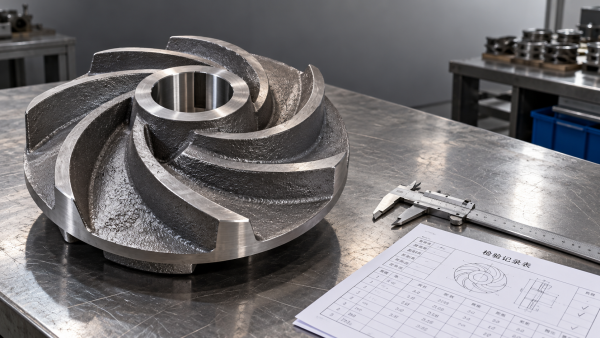
Impeller geometry influences how often fibers contact a surface where they can lodge. Examine the inlet, blade leading edges, hub region, and transitions into the discharge passage. Smooth contours and a clear flow path can reduce opportunities for snagging, but a drawing alone cannot establish reliable fiber handling. Material behavior and local flow conditions still determine whether contact develops into accumulation.
A recessed or vortex impeller can reduce direct contact between transported material and the impeller because much of the material travels through the casing outside the impeller passages. That makes the arrangement worth evaluating for mixed debris. It does not eliminate blockage risk at the suction opening or elsewhere, and its efficiency and wear behavior must be assessed for the required slurry duty.
Channel impellers provide defined passages through the impeller and may offer a useful balance of solids handling and hydraulic performance. Their fiber-handling behavior depends on the entrance shape, blade arrangement, and local flow. An open or semi-open impeller may provide accessible passages, yet its clearance relationships and exposed edges still need examination. These design labels describe broad arrangements; they do not provide a dependable ranking for every fibrous slurry.
Some impellers incorporate swept leading edges or other features intended to move fibers toward a location where they can release. Such features deserve closer attention than a general “non-clog” designation. Ask which materials the geometry has been evaluated with, at what flow conditions, and whether it sheds accumulating fibers during sustained operation. A feature that clears occasional strands may perform differently under repeated rag loading.
Cutting and grinding arrangements address the problem through size reduction, but they introduce another selection question. Hard, abrasive solids can affect cutting components and their clearances, while some downstream processes require fibers to remain intact. If cutting is proposed, evaluate it against the complete mixture and maintenance requirements. Adding a cutting mechanism does not by itself establish suitability for abrasive slurry service.
Internal clearances require similar care. Increasing an opening may improve passage in one location while changing efficiency, recirculation, or wear behavior elsewhere. Wear can alter both hydraulic performance and the surfaces fibers encounter. Evaluate the pump in its specified condition and consider how service wear could affect fiber handling; avoid assuming that progressively larger clearances will progressively improve reliability.
Define the fiber load and the operating conditions together.
Before comparing pump models, describe the feed well enough to distinguish a manageable suspension from an intermittent ragging problem. Average solids concentration is useful, but it can conceal the events that stop a pump. A low average fiber content may include occasional long strips or dense bundles released during tank cleanout, flushing, or a process upset.
The most useful application information includes:
- Fiber characteristics: material, representative lengths, longest credible pieces, thickness, flexibility, and whether strands arrive loose, tangled, or attached to other debris.
- Hard-solids characteristics: particle dimensions, shape, density, abrasiveness, and the likelihood of irregular or oversized objects.
- Mixture behavior: solids concentration and its measurement basis, tendency to settle or form mats, apparent viscosity, and variation between normal operation and concentrated slugs.
- Operating range: required flow and head, minimum sustained flow, speed-control range, start-stop frequency, and conditions after an idle period.
- Feed arrangement: sump or tank geometry, suction restrictions, upstream screening, and any mixing or flushing used to keep material moving.
These details help explain why apparently similar services can produce different outcomes. Dispersed process fibers entering a well-mixed feed can behave very differently from rope, fabric strips, and film entering intermittently with mineral solids. The latter mixture gives flexible material more opportunities to loop, anchor, and form composite obstructions. A pump selected for the first service should not be transferred to the second on solids-passage size alone.
Concentration changes the transport problem as well. As fiber loading increases, fibers may interact and form networks or bundles instead of moving independently. The carrier liquid’s ability to move the mixture through the pump may also change. A clean-water performance curve therefore cannot, by itself, confirm the operating point or power demand for the actual slurry.
Flow conditions matter because material must reach the pump, pass through it, and continue along the discharge line. At reduced throughput, settling or accumulation can develop in parts of the system even when the pump has adequate internal passage. Variable-speed operation deserves particular attention: reducing speed changes the pump’s head and flow, and the resulting conditions may no longer transport the mixture reliably. Higher speed is not a universal remedy, since it also changes power demand and wear exposure.
Check where an obstruction is likely to begin. A restricted suction fitting, a collection point in the sump, or an unsuitable valve can stop material before the impeller’s fiber-handling features have any effect. The pump and piping must be assessed as a connected flow path. Otherwise, a system blockage may be attributed to the pump, or a successful pump trial may conceal an installation weakness.
Verification should reveal accumulation over time.
The strongest selection evidence is operation with a representative mixture under conditions that reflect the intended service. A brief demonstration showing fibers emerge from the discharge proves immediate passage. It provides limited evidence about whether small quantities remain behind and accumulate over repeated exposures. The test needs enough duration and loading cycles to expose that mechanism.
Use the expected range of fiber types, lengths, and concentrations, including credible difficult conditions. Where the application includes hard solids, include them with the fibers so the test captures their interaction. Any substitutes should have comparable flexibility, strength, surface behavior, and tendency to tangle. Convenient test material can give an optimistic result if it breaks apart or slips through more easily than the actual feed.
The hydraulic arrangement also needs to represent the duty. An unrestricted discharge can create flow conditions that will not exist against the installation’s system resistance. Evaluate the expected operating range, especially minimum-flow periods, and include starts, stops, or idle periods when these are part of normal service. Define test boundaries explicitly so a successful result is not extended to materially different conditions.
Agree on acceptance criteria before testing. Useful measures include sustained flow and head, power or motor-current trends, vibration where relevant, and the number of interventions needed to maintain operation. A gradual loss of flow or a changing power trend can indicate developing accumulation, although those signals require interpretation alongside other operating data. “The pump did not trip” is too weak a criterion if throughput steadily deteriorated.
Inspection after the test adds evidence that operating measurements can miss. Look for strands around the hub, material retained on leading edges, compacted deposits, and fibers trapped near clearance surfaces. A pump may still meet its duty at the end of a short run while carrying an accumulation that would become disruptive later. Record what remains inside, as well as what passes through.
When a representative trial is impractical, request application evidence with enough detail to judge its relevance. Similarity should cover fiber form, hard-solids content, concentration, pump configuration, and operating range. A reference involving short dispersed fibers offers limited support for a duty dominated by long textile strips. Uncertainty should translate into a defined operating envelope and a practical means of inspection or clearing.
Selection can then follow the dominant failure mechanism. Where dispersed fibers accompany large solids, a suitable passage and a geometry that avoids retaining fibers may be sufficient, subject to verification. Where long, flexible debris dominates, demonstrated resistance to wrapping deserves greater weight. Where abrasive particles and entangling fibers create competing demands, screening, feed preparation, or a different pumping arrangement may offer a more reliable route than changing the impeller alone.
Non-clog slurry pumps can handle both material types when the geometry, mixture, and operating conditions are compatible. The purchasing specification should therefore pair the required solids passage with a defined fiber challenge and an agreed method of demonstrating sustained performance. That gives technical evaluators a defensible basis for selection—and makes clear which changes in feed or operation would require the choice to be reviewed.
Related Information
 Oct 30, 2026
Can a Knife Gate Valve Achieve Zero Leakage in Abrasive Slurry?
Can a knife gate valve maintain zero leakage in abrasive slurry service? Discover the design, testing, and maintenance factors that affect tight shutoff.- Oct 30, 2026
How to Verify High-Chrome Pump Casting Quality Before Shipment
How do I verify the quality of high chrome pump castings before shipment? Discover essential material, hardness, dimensional and traceability checks to ship with confidence.  Oct 30, 2026
Sizing Froth Pumps for Flotation Circuits: Accounting for Entrained Air
Size Froth Pumps with confidence. Learn how entrained air affects inlet flow, hydraulic duty, and pump selection to improve flotation circuit reliability and compare supplier proposals.- Oct 30, 2026
Slurry Knife Gate Valves Won't Close Fully? Check Solids Buildup and Seat Wear
Slurry Knife Gate Valves won't close fully? Learn how to identify solids buildup, inspect seat wear, and choose the right repair to restore reliable shutoff and reduce downtime.



{item.title}
Get a Quote
Please leave your information and email address, and we will contact you as soon as possible.