
Can a Centrifugal Pump Handle Cement Slurry Without Settling?
Will a centrifugal pump handle my cement slurry without settling? It can, but the pump alone cannot guarantee that cement particles will remain suspended. Reliable transport depends on the slurry’s properties, the velocity in the pipe, the layout of the system, and what happens when the flow stops.
That distinction matters when a line runs smoothly during production but becomes difficult to restart after a break. A pump may have enough pressure for the intended duty and still leave solids behind in a slow-moving section of pipe. To reduce that risk, treat the pump, pipeline, mixing arrangement, and operating procedure as one system.
What makes cement slurry settle?
Cement slurry is not always a simple mixture of cement and water. Depending on the application, it may also contain sand, fillers, additives, or other solids. These ingredients influence density, viscosity, abrasion, and the speed at which particles separate from the liquid.
In a moving pipeline, the flow can help keep solids distributed. When velocity falls, heavier particles may collect along the bottom of a horizontal pipe. In vertical sections, insufficient upward flow can allow particles to fall back. Low points, oversized pipes, long idle branches, and poorly mixed feed tanks can all become places where deposits begin.
Cement adds another concern: it reacts with water. A line can therefore develop problems not only from physical settling, but also from slurry thickening or setting over time. Keeping the pump running may help maintain movement, but it does not stop hydration indefinitely. The allowable working time must be established for the actual mix and conditions.
Start with the slurry, not the pump catalog
Before deciding whether a centrifugal pump is suitable, gather representative information about the material you intend to move. A supplier needs more than the name “cement slurry” to make a useful recommendation.
- Solids concentration: Record whether the value is expressed by weight or by volume. The distinction affects density and sizing calculations.
- Particle characteristics: Identify the particle size distribution and whether abrasive materials such as sand are present.
- Slurry density and flow behavior: Measure these at the intended operating temperature and concentration. Some cement mixtures behave differently from water and may develop a yield stress.
- Working time: Determine how long the mix can remain pumpable, including possible waiting periods and temperature effects.
- Variation during operation: Consider the thickest mix, the lowest expected flow rate, and changes caused by batching or water adjustment.
Where practical, test a representative mixture rather than relying only on nominal recipe values. Small changes in water content or solids can alter how a slurry flows and how quickly it separates. If the mixture is non-Newtonian or contains coarse settling solids, specialist testing and slurry-specific calculations may be needed; a water-based pump calculation can be misleading.
Find a flow rate that keeps the line moving
The central question is not simply whether the pump can move slurry through the pipe. It is whether the system can maintain enough velocity to limit deposition under normal and reduced-flow conditions.
For a given flow rate, a larger pipe produces a lower average velocity. Increasing pipe diameter can reduce friction, but it may also allow solids to settle. A smaller pipe raises velocity at the same flow rate, although it can increase friction losses and wear. The useful pipe size is therefore a balance, not automatically the largest size available.
The minimum transport velocity depends on the mixture and pipeline. There is no single safe velocity for every cement slurry: particle size, solids concentration, rheology, pipe diameter, and orientation all matter. Ask a qualified slurry-system designer or pump supplier to estimate the deposition risk using appropriate methods and, where uncertainty is significant, confirm the design with testing.
Also check the other end of the operating range. Excessive velocity can accelerate abrasion, particularly at bends and valves. The aim is a practical operating window: fast enough to control deposition, but not so fast that wear and energy consumption become unnecessarily high.
Check flow when production is not at its best
A line may be adequately sized at full production and vulnerable when the operator slows the pump, closes a valve, or runs only one branch. Review the lowest sustained flow rate as carefully as the normal duty point. If a variable-frequency drive is used, establish a minimum operating speed that still provides sufficient flow through the actual system; lower pump speed does not automatically mean acceptable slurry transport.
Where multiple discharge branches are possible, consider how flow is divided. One branch may look healthy while another receives too little flow to prevent accumulation. Flow measurement in the relevant lines can make that problem visible before a restriction develops.
Select a centrifugal pump for slurry duty
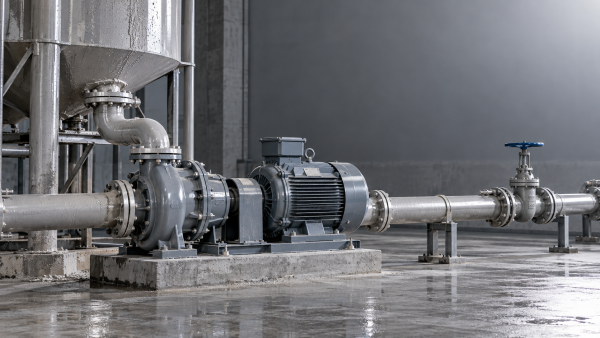
Centrifugal pumps are widely used for slurries, but a pump intended for clean water is not necessarily a good choice for cement service. The selection should reflect the solids, required flow, total dynamic head, suction conditions, and expected operating range.
For abrasive or solids-containing mixtures, a slurry-duty centrifugal pump may be appropriate. Features to discuss with the supplier include:
- Impeller and passage geometry: Passages must accommodate the solids and reduce the chance of plugging. The appropriate impeller design depends on the actual particle sizes and duty.
- Wear materials: Casing, impeller, and liner materials should suit the abrasion and chemical exposure expected from the mix.
- Seal arrangement: Cement particles can damage seals. Confirm the sealing method, flush requirements, and compatibility with the process.
- Maintenance access: Wear parts will need inspection and eventual replacement. Access matters when slurry can harden inside equipment.
- Duty point: Check the pump curve against the slurry system, not just the clean-water curve. Slurry properties can affect pump performance and power demand.
The suction side deserves particular attention. A pump that is starved of feed may lose performance, draw air, or cavitate. Evaluate available net positive suction head under actual conditions and compare it with the pump manufacturer’s requirements, including an appropriate margin. Keep suction piping as short and direct as practicable, while following the manufacturer’s recommendations for the installation.
Build the pipeline around restart and cleaning
Settling problems often appear during transitions rather than steady operation. A shift ends, a batch is delayed, or a downstream valve closes. The design should account for those moments before the first batch enters the line.
Provide a cleaning and flushing arrangement suited to the plant and the slurry. Plan where flush water will enter, where displaced material will go, and how the pump and low points will be cleared. Confirm that adding water is acceptable for the process and that waste slurry and wash water are handled according to site requirements. A flush connection is useful only if the procedure reaches the areas where material can remain.
Operate to prevent deposits, not just react to them
Once the installation is commissioned, consistent operation matters as much as equipment selection. Operators should know the acceptable mix range, minimum flow, maximum practical idle time, and the response to an interruption.
Keep the feed uniform
Agitation in the feed vessel can help prevent solids from collecting before they reach the pump. Check whether the agitator keeps the whole vessel moving, including near the outlet and corners. A pump cannot deliver a consistent slurry if the tank sends it alternating pockets of thin liquid and concentrated solids.
Follow the approved batching procedure rather than adding water solely to make a difficult mix easier to pump. Dilution changes the process mixture and may affect the finished application. Any adjustment should be assessed against the mix specification.
Watch for changes in the system
Useful operating signals include flow rate, suction and discharge pressure, motor load, tank level, and changes in noise or vibration. A declining flow or rising pressure may indicate a developing restriction, although other causes are possible. Compare readings with a known, stable operating baseline instead of assuming that one measurement identifies the fault.
If a deposit or blockage is suspected, follow the site’s isolation and cleaning procedures. Do not open a pressurized line or attempt an uncontrolled restart. Cement slurry can leave a line obstructed even after the pump stops, so verify that equipment is safely isolated and depressurized before maintenance.
Plan for shutdowns before they happen
For planned stops, flush and drain according to a procedure established for the installation and mix. For unexpected interruptions, operators need a clear decision point: how long can slurry remain in the system, and when must it be removed? That limit should come from the actual material’s pumpability and setting behavior, not a generic rule.
Restarting into a partially settled line may require more pressure than the pump can provide and can make a restriction worse. Do not assume that simply increasing speed will clear it safely. Inspect and clean as required under the site procedure, then confirm that flow and pressure have returned to normal.
When might another pump type be worth considering?
A centrifugal pump is a strong candidate when the slurry can be kept moving within a suitable flow range and the system is designed for its solids and wear characteristics. It may be less attractive when the required flow is very low or variable, the mixture is highly viscous or has a significant yield stress, or the available pump cannot meet the duty without operating far from its suitable range.
In those situations, a positive-displacement pump may deserve evaluation. It still will not eliminate settling in a stationary pipe, and it introduces its own requirements, including appropriate overpressure protection. The choice should be based on the complete duty and operating procedure rather than on pump type alone.
The practical answer is therefore conditional: a centrifugal pump can handle cement slurry with a well-designed pipeline, a suitable operating velocity, a uniform feed, and a reliable flushing plan. Before committing to equipment, validate the slurry properties and review both steady operation and interruptions with the pump and system suppliers. That preparation gives the pump a fair chance to do its job—and gives the plant a clearer plan when the flow has to stop.
Related Information
 Oct 31, 2026
Can a Centrifugal Pump Handle Cement Slurry Without Settling?
Will a centrifugal pump handle my cement slurry without settling? Discover how pump selection, flow velocity and flushing help reduce deposits.- Oct 31, 2026
Knife Gate Valve or Pinch Valve: Which Is Better for Tailings?
Should I choose a knife gate valve or a pinch valve for tailings? Compare wear, sealing, pressure limits and maintenance costs to find the right fit. - Oct 30, 2026
Can a Knife Gate Valve Achieve Zero Leakage in Abrasive Slurry?
Can a knife gate valve maintain zero leakage in abrasive slurry service? Discover the design, testing, and maintenance factors that affect tight shutoff. - Oct 30, 2026
How to Verify High-Chrome Pump Casting Quality Before Shipment
How do I verify the quality of high chrome pump castings before shipment? Discover essential material, hardness, dimensional and traceability checks to ship with confidence.


{item.title}
Get a Quote
Please leave your information and email address, and we will contact you as soon as possible.