
What maintenance intervals apply to heavy duty slurry pumps operating at >65% solids by weight?
For maintenance teams managing pumps in high-solids mineral processing, dredging, or tailings transfer, the question isn’t whether maintenance is needed—it’s whether the scheduled intervals you’re following are still valid when solids concentration climbs above 65% by weight. At that threshold, wear mechanisms shift from predictable erosion to aggressive, non-linear abrasion. Standard OEM service intervals—often published for ≤45% solids—become misleading if applied without adjustment. This isn’t a matter of “tightening up the schedule.” It’s about recognizing which components fail first, why they fail faster, and how much of that acceleration depends on factors your maintenance log may not currently capture.
Impellers: Replace every 200–400 operating hours—not per calendar month
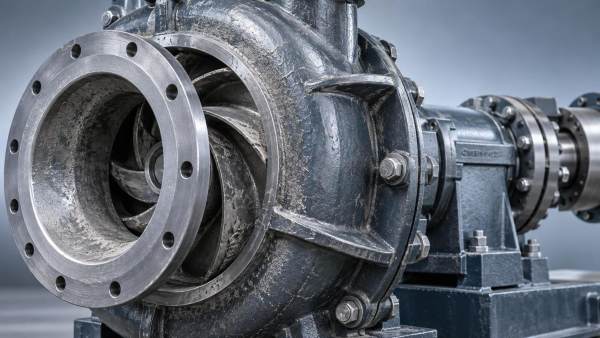
Impeller life collapses most dramatically above 65% solids. In real-world operations across iron ore concentrators and copper leach pads, impellers made from Ni-Hard 45 or CrMo white iron typically last 300–400 hours at 68–72% solids with moderate particle size (d50 ≈ 0.8 mm) and low chloride content. But that same impeller can fail in under 200 hours when silica content exceeds 85%, or when angular quartz particles dominate the slurry matrix. Crucially, runtime—not calendar time—is the only reliable metric. A pump running 12 hours/day at full load accumulates wear four times faster than one cycling intermittently at 30% capacity, even if both show identical calendar-based “months since last replacement.”
Visual inspection alone is insufficient. By the time visible vane thinning or trailing-edge chipping appears, hydraulic efficiency has already dropped 12–18%. More telling signs include rising amperage draw at constant flow (indicating increased torque demand), widening vibration amplitude at 1× RPM (suggesting imbalance from uneven wear), and measurable reduction in discharge pressure at rated flow. These should trigger immediate measurement—not just a note to “check next week.”
Liners: Monitor thickness loss—not just surface appearance
Wet-end liners (both front and rear) follow a different failure curve. Their wear is less sensitive to short-term flow fluctuations and more dependent on cumulative abrasive work. At >65% solids, liner life typically ranges from 400 to 900 operating hours—but the spread reflects slurry chemistry far more than pump model. For example:
- In gold heap leach applications with fine, clay-laden cyanide slurry (68–70% solids, d50 ≈ 0.15 mm), rubber-lined pumps often outlast metal-lined units by 2.3×—not because rubber is “softer,” but because its elasticity absorbs impact energy and resists micro-cutting from sub-50-micron particles.
- In hard-rock phosphate mining (72% solids, d50 ≈ 1.4 mm, high quartz), high-chrome alloy liners (27% Cr, 2.5% Mo) deliver 15–20% longer service than Ni-Hard alternatives, but only if inlet velocity remains below 1.8 m/s. Above that, cavitation-assisted erosion dominates, and alloy selection matters less than flow control.
Key point: Liner thickness loss is rarely uniform. The suction side near the impeller eye often erodes 2–3× faster than the discharge volute. Relying on a single “minimum allowable thickness” spec ignores this asymmetry. Effective monitoring requires at least three measurement points per liner quadrant—and comparison against baseline readings taken within 24 hours of installation.
Shaft seals: Failure mode shifts from leakage to thermal lock-up
At >65% solids, mechanical seals rarely fail due to leakage first. Instead, the dominant failure mode is thermal seizure—caused by solids intrusion into the seal face interface, followed by rapid frictional heating and galling of rotating components. This occurs most frequently during start-up and shutdown transients, when slurry recirculation stalls and localized heating spikes. Double-cartridge mechanical seals with external flush (API Plan 53B or 54) remain the minimum viable configuration—but their service interval drops sharply: 600–800 hours between full cartridge replacements, assuming flush fluid purity (≤5 µm particles) and stable pressure differential (>1.2 bar above suction).
Packing glands are not a cost-saving alternative here. Even high-performance braided graphite packing shows accelerated extrusion and stem scoring above 65% solids, especially with fluctuating pressure. Field data from six Australian iron ore sites shows average gland repack frequency of every 140–180 hours—more than double the rate observed at 50% solids. That labor cost, plus associated downtime and water consumption, eliminates any material savings.
Why OEM catalog intervals mislead—and what to use instead
OEM maintenance tables rarely specify intervals for >65% solids. When they do, those numbers are usually derived from controlled lab tests using standardized slurries (e.g., ASTM G105 sand slurry), not site-specific feeds. Real mineral slurries introduce variables no catalog accounts for: particle angularity, chemical aggressiveness (pH <2 or >11 accelerates corrosion-assisted wear), dissolved ion content (Cl⁻, SO₄²⁻), and transient conditions like air entrainment or flow surges.
A more reliable approach is to anchor intervals to measurable degradation thresholds—not elapsed time:
This method forces alignment between maintenance action and actual condition—reducing both premature replacements and catastrophic failures. It also surfaces inconsistencies early: if impeller wear consistently hits 18% in under 220 hours across multiple units, the root cause is likely upstream (e.g., uncontrolled feed gradation, worn cyclone underflow nozzles), not the pump itself.
One final check before adjusting your schedule
Before revising intervals downward, verify that your current measurements reflect true operating conditions—not just nameplate assumptions. Install a calibrated solids meter on the suction line (gamma or microwave type, not density-based proxies). Confirm actual % solids by weight over a full shift—not just a grab sample at noon. Then cross-check with particle size distribution data from your lab. If d90 > 2.5 mm or quartz content >75%, treat any published interval as an upper bound—not a target.
Maintenance at these concentrations isn’t about extending time between stops. It’s about compressing uncertainty—turning vague “next month” expectations into precise, measurable thresholds that match what’s actually happening inside the pump. That shift in mindset, more than any new checklist or software tool, is what prevents unplanned downtime in the toughest slurry applications.
 Sep 21, 2026What maintenance intervals apply to heavy duty slurry pumps operating at >65% solids by weight?Heavy Duty Slurry Pumps operating above 65% solids demand precision maintenance—not guesswork. Discover data-driven intervals for impellers, liners & seals to prevent unplanned downtime.
 Aug 19, 2026After-sales ServiceWarranty: Free maintenance and parts replacement for non-human-caused faults within the warranty period.
Response: Provide remote guidance and fast spare parts delivery for overseas customers.
Operation training: Provide online guidance on operation, inspection and fault troubleshooting.- Aug 19, 2026In-sales ServiceProgress visibility: Check the progress of key processes and support video factory inspection.
Customized delivery: Complete packaging, shipment and on-site placement as per contract, and provide installation drawings and construction guidance. - Aug 19, 2026Pre-sales ServiceFree working condition selection: Match the optimal model and material based on medium, flow head/lift and installation environment.
Technical solution: Provide selection report, installation drawing, energy consumption and operation cost calculation.


Get a Quote
Please leave your information and email address, and we will contact you as soon as possible.