
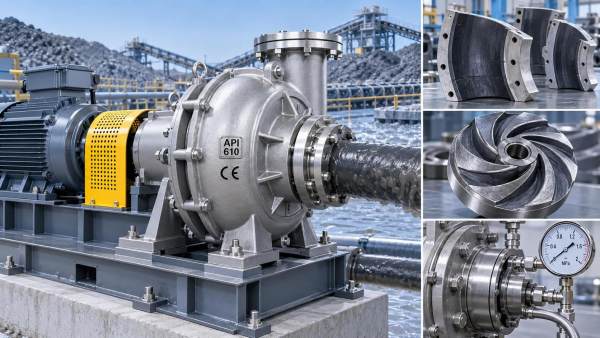
Yes—Chinese-manufactured slurry pumps are increasingly reliable for overseas mining projects, provided they come from manufacturers with verifiable international certifications and documented field performance under comparable operating conditions. This is not a blanket claim, but a conclusion supported by procurement patterns across active mining regions: EPC contractors in Chile’s copper belt, operations teams managing iron ore dewatering in Liberia, and coal site engineers in Indonesia have selected Chinese-made slurry pumps where ISO 9001 (quality management), ISO 14001 (environmental management), CE (EU conformity), and API 610 (rotodynamic pump design) certifications were confirmed—and where spare parts availability, service response time, and abrasion resistance matched project-specific duty cycles.
Reliability here isn’t measured solely by startup success or 30-day runtime. It’s defined by sustained performance over 12–24 months in high-solids, high-abrasion, variable-flow environments—where seal life exceeds 6,000 hours, casing wear rates remain below 0.15 mm/year under 45% wt solids, and impeller replacement intervals align with planned maintenance windows—not emergency shutdowns. When these metrics are consistently reported across multiple sites with similar slurry composition (e.g., silica-rich tailings, hematite-laden runoff, or coal fines with pH 4.8–6.2), the reliability question shifts from “Are they reliable?” to “Which models meet *our* duty point, material specification, and support infrastructure?”
Certifications: Gatekeepers, Not Guarantees
ISO 9001 and ISO 14001 confirm that a manufacturer maintains documented quality control processes and environmental compliance—but they do not specify pump hydraulics, metallurgy, or bearing life. CE marking indicates conformity with EU health, safety, and environmental requirements, yet it applies to the final assembled unit; subcomponents (e.g., mechanical seals, shaft sleeves) may originate from third-party suppliers whose traceability must be verified separately. API 610 is more directly relevant: Edition 12 (2023) requires vibration limits ≤ 4.5 mm/s RMS at operating speed, minimum casing thickness based on design pressure and material grade, and mandatory NPSHr testing at three flow points. However, API 610 compliance alone doesn’t guarantee suitability for mine-specific slurries—especially those containing sharp-edged particles >2 mm or operating at suction pressures below atmospheric.
What matters operationally is whether certification documentation includes:
- Test reports signed and stamped by an accredited third-party lab—not internal QA records;
- Material certificates (e.g., ASTM A890 Grade 4A for duplex stainless casing, ASTM A494 M30Cu for impellers) matching the pump’s nameplate;
- Hydraulic performance curves validated at full-scale, not interpolated;
- Seal chamber pressure ratings explicitly stated for closed-loop flush plans used in remote mine sites.
Without these, certification becomes administrative paperwork—not evidence of fitness for purpose.
Field Data: What to Request—and How to Read It
Real-world reliability emerges not from brochures, but from auditable field data tied to specific pump models and duty points. Procurement teams should request, at minimum:
- Uptime logs covering ≥12 consecutive months from ≥3 sites with slurry SG ≥1.35, solids content ≥30% wt, and average particle size D50 ≥0.8 mm;
- Maintenance records showing mean time between failures (MTBF) for critical components: shaft seals, bearings, impellers, and throat bushings;
- Corrosion/erosion inspection reports with calibrated thickness measurements taken at standardized locations (e.g., volute inlet, impeller vane trailing edge, suction liner at 90° and 270°);
- Spare parts lead times for wear components under standard shipping terms—not just air freight estimates.
Crucially, this data must reflect actual operating conditions—not idealized test bench results. For example, a reported 18-month impeller life is only meaningful if the site’s slurry analysis confirms consistent 38% wt solids with quartz content >72%. If field data shows repeated seal failure at one site but not another, cross-check suction piping configuration: unbalanced flow or vortex formation upstream can accelerate seal wear regardless of pump build quality.
Where Context Overrides Certification
Two identical API 610-certified pumps can deliver vastly different reliability outcomes depending on application context:
A pump rated for 20 years of service life may last only 3 years if operated 22 hours/day in a mine with unstable grid power and no voltage regulation—regardless of its certifications. Reliability is co-determined by equipment specification *and* system integration.
Procurement Due Diligence That Moves Beyond Brochures
Before approving a Chinese-manufactured slurry pump for overseas deployment, verify the following—not once, but at three stages:
- Pre-award: Require factory witness testing per API 610 Annex F, with your engineer present—or appoint an independent inspector with API RP 582 qualification. Confirm test fluid matches your slurry density and viscosity profile.
- Pre-shipment: Audit serial-number-matched material certs and non-destructive testing (NDT) reports for casing welds and impeller castings. Reject units without full traceability back to heat lot numbers.
- Post-commissioning: Conduct baseline vibration analysis within 72 hours of first operation, then repeat at 500, 1,000, and 2,000 running hours. Trend amplitude at 1×, 2×, and bearing fault frequencies—not just overall RMS.
This level of diligence separates proven reliability from assumed reliability. It also creates a baseline for comparing future performance against contractual warranty terms—particularly clauses covering wear component life under defined slurry conditions.
When Reliability Is Non-Negotiable—And When It Isn’t
For primary dewatering duty on active pit dewatering systems or tailings transfer lines feeding thickener feed wells, reliability thresholds are strict: unplanned downtime carries direct production cost penalties and safety risks from overflow or pump cavitation-induced vibration. Here, prioritize pumps with ≥24 months of documented uptime in similar applications—and insist on local technical support coverage (not just regional hubs).
For secondary duties—like sump evacuation in auxiliary workshops or low-duty-cycle backfill mixing—the bar can be lower. A pump with ISO 9001 + CE certification, 12-month field data from two sites, and readily available spares may suffice—if failure triggers only minor workflow delays, not process interruption.
The distinction isn’t about geography or origin—it’s about consequence. Chinese manufacturers now span that spectrum. The task is matching pump capability to consequence severity—not applying a country-wide reliability score.
 Sep 19, 2026Are Chinese-manufactured slurry pumps reliable for overseas mining projects—what certifications and field data confirm this?Are Chinese slurry pumps reliable enough for overseas mining projects? Yes—when backed by API 610, ISO, CE certifications & real-world field data from Chile, Liberia & Indonesia.
 Aug 19, 2026CEISO
- Aug 19, 202640000m2
- Aug 19, 202613000m2/h

Get a Quote
Please leave your information and email address, and we will contact you as soon as possible.